Contents


















Contents








WELCOME TO LODI
Thank you for reading the Lodi District Chamber of Commerce’s 2026 Business Directory and
Relocation Guide. Our chamber is proud to be the preeminent organization representing the small
businesses that are the heartbeat of the Lodi community. From charming boutiques to cozy cafes, our
local entrepreneurs bring creativity, passion and a unique flair that defines our town. These
businesses, often family-owned and multi-generational, are the foundation of our local economy and add
to the close-knit, friendly atmosphere that makes Lodi so special.
What an exciting time to be in Lodi. It's been a season that has ushered in new developments and
revitalization of many public spaces. Our treasured Lodi Lake has been enhanced for beauty and
accessibility. Improvements include reconstructing the southern and Hughes Beach parking lots, the
eastern access road, the southern restroom building and restrooms added at Hughes Beach and the nature
area parking lot. Some of our playground equipment has been upgraded; new picnic structures at Hughes
Beach; and concrete pathways, lighting and picnic tables also add to the beauty that is already there.
These upgrades make Lodi Lake an even better place for families and visitors to enjoy.
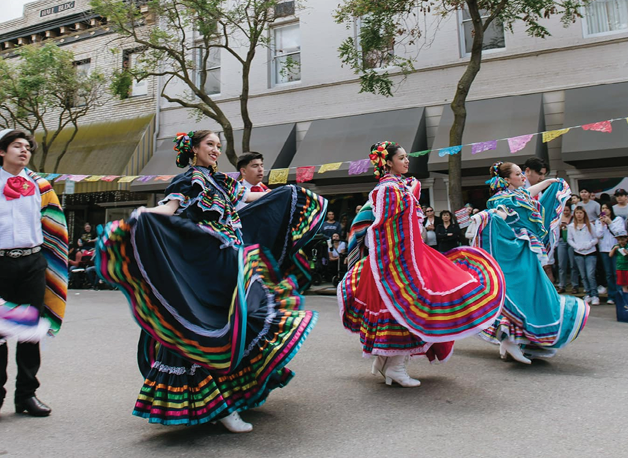
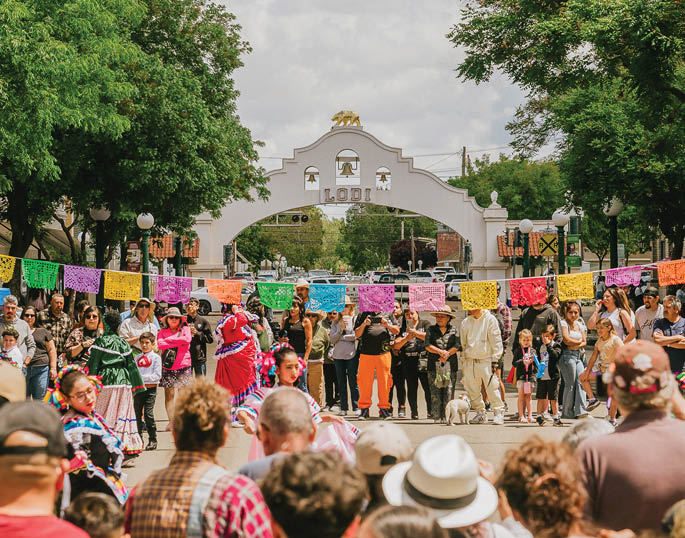
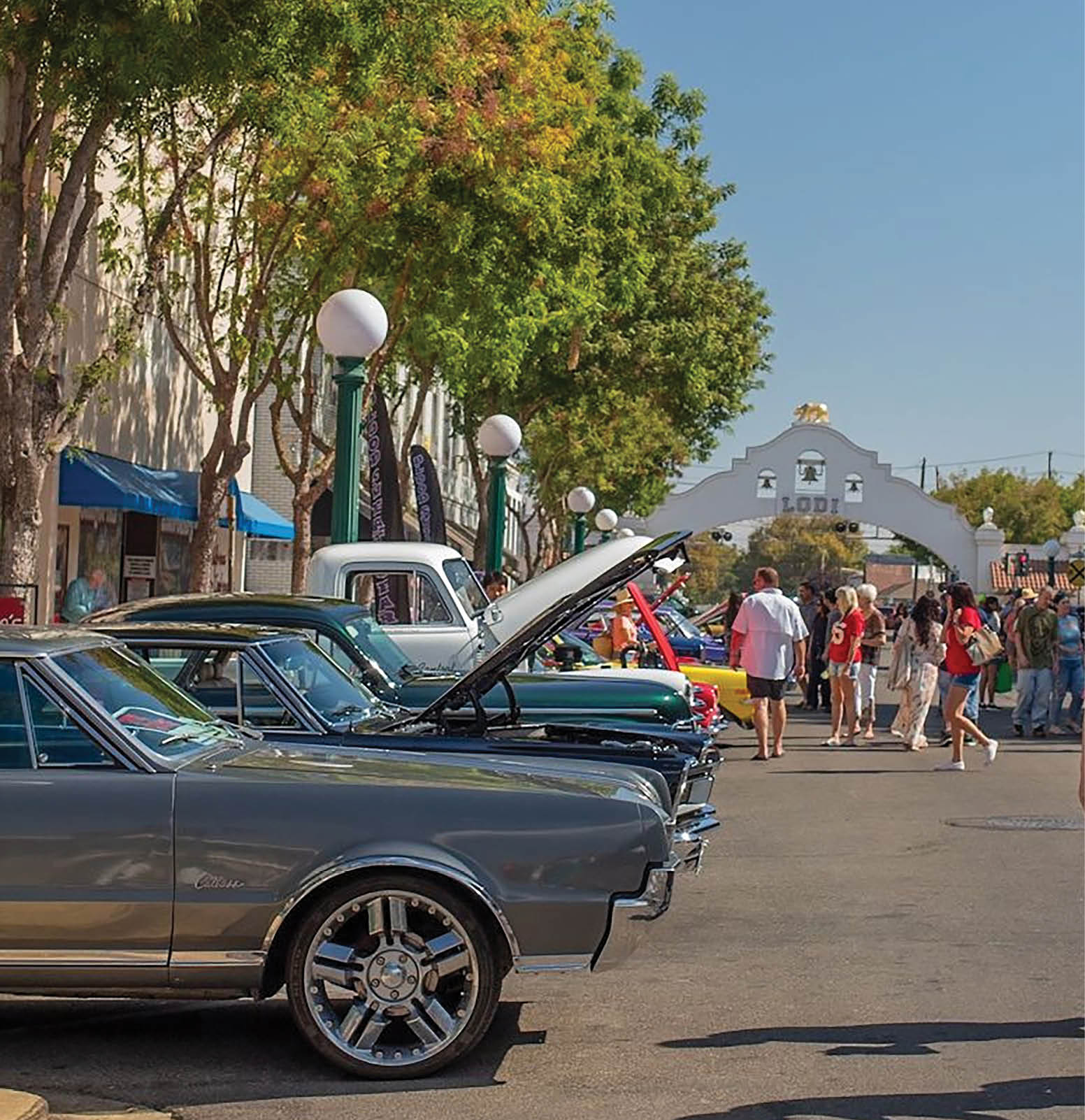
If you have never been, don’t miss the Lodi Street Faire, hosted each spring and fall by the Lodi
Chamber of Commerce! Held on the first Sunday of May and October, the Street Faire turns our downtown
into a lively marketplace, attracting vendors and visitors from all over Northern California. With over
400 hundred booths featuring antiques, crafts and delicious food, it’s a celebration unlike any
other in the San Joaquin Valley. Mark your calendar and join us for a fun-filled day!
In this year’s edition of the Lodi Relocation Guide and Business Directory, we have some exciting
new features. Check out our Five Questions with the Lodi Fire Department and see why our local
heroes take safety so seriously. We also feature extended stay hotel options, including the new
Residence Inn, and spotlight popular coffee spots in the area and one of Lodi’s wineries that
offers oil tastings.
Thank you for reading and we look forward to seeing you around town!
Best Regards,
JP Doucette
President & CEO • Lodi District Chamber of Commerce











BOARD OF DIRECTORS
Matt Teresi
Board Chair
Owner
Cherrease
Rebecca Towell
Vice President
Relation Insurance
Jon Rader
Owner
State Farm Insurance
Pete Murdaca
Owner
Pietro's
Paul Lanning
Executive Director
HealthForce Partners
Wes Rhea
CEO
Visit Lodi
Steve Diede
Owner
Diede Construction
Mona Shulman
VP/HR & General Counsel
Pacific Coast Producers
Mark Meehleis
Owner
Meehleis Modular
Michael Coldani
Owner
Calivirgin Winery & Olive Mill
Summer Pennino
Owner
SNP Events
Neil Young
Superintendent
Lodi Unified School District
Brooke McCollough
Operations
Adventist Health
Aaron Shinn
Owner
Round Valley Ranches











COMMITTEES
The Agribusiness Committee provides critical information to Agribusiness owners and growers in the Lodi
area. The Agribusiness Committee hosts Farm Safety Day annually to provide the latest information on how
to protect workers. They also host Grape Day in partnership with the UC Cooperative Extension of San
Joaquin County that informs farmers on new trends and techniques in viticulture.
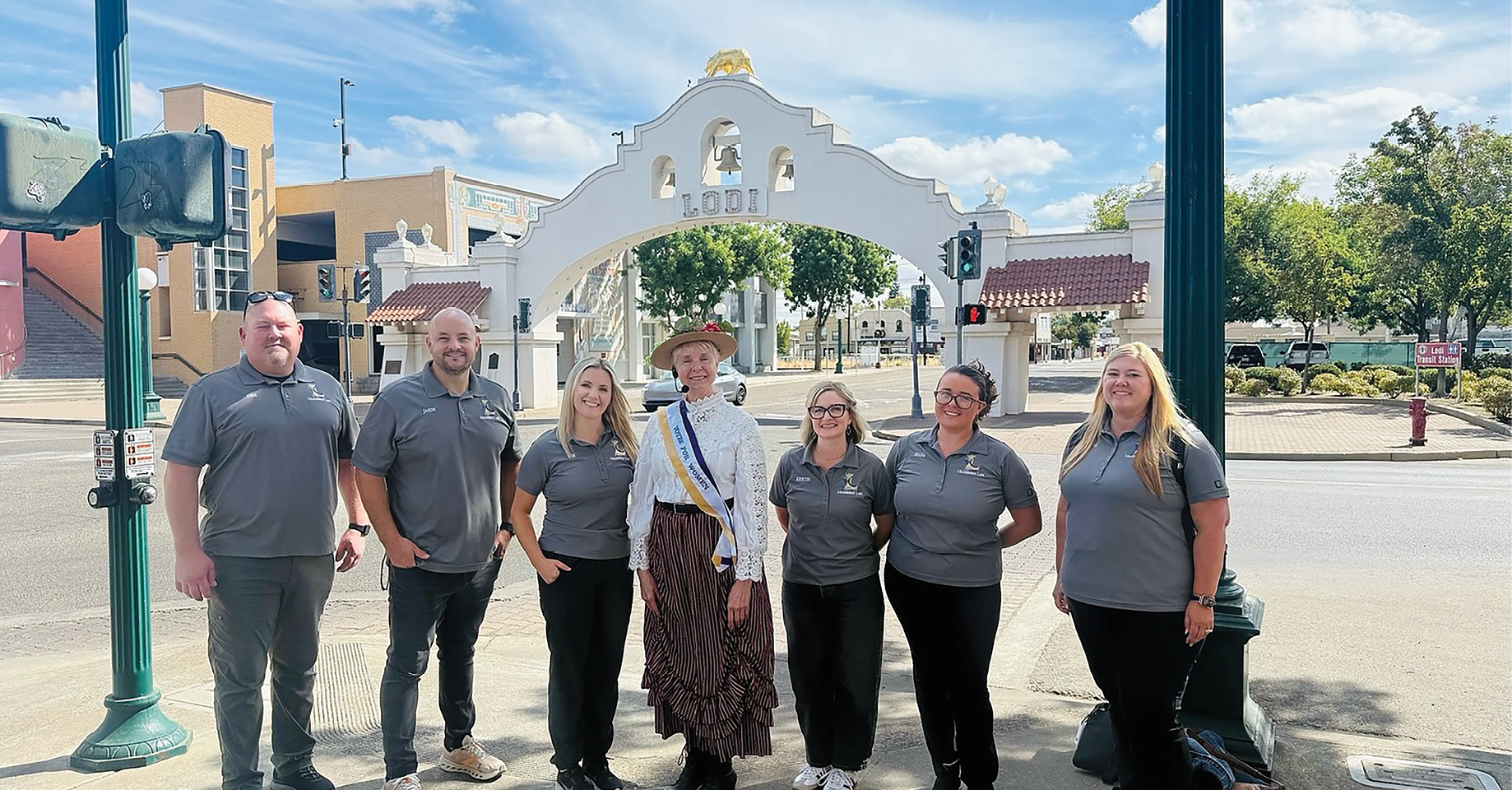
The Ambassadors are the hard-working public face of the Lodi Chamber of Commerce. The Ambassador
Committee provides unlimited networking opportunities that include ribbon cuttings, milestone
anniversaries and mixers. Ambassadors also make up the volunteer army that is essential to running
Chamber events.
The Business Development Committee is comprised of local business people looking to help make Lodi a
place where businesses of all sizes can thrive. The Committee works in partnership with local and
regional economic and workforce development agencies to ensure Lodi’s businesses have the
resources they need to take their business to the next level.
The Government Relations Committee (GRC) is the advocacy arm of the Chamber of Commerce. This Committee
meets regularly with the offices of our local elected officials to represent the interests of Lodi
businesses. The GRC also works in conjunction with other Chambers of Commerce to fight against
anti-business legislation and to promote a growth-minded legislative agenda.
Since 1990 Leadership Lodi has inspired and motivated Lodi area citizens to achieve higher levels of
leadership responsibility. The program provides participants with the necessary information to
understand the complexities of the Lodi community and provides students with the opportunity to meet and
exchange ideas with current community leaders. Participants will discuss, explore and learn about
leadership dynamics, government, education, law, agribusiness, economic development, health and the
arts.
The Street Faire Committee is the driving force behind Downtown Lodi’s largest bi-annual event.
Each May and October, committee members dedicate their time, resources and expertise to ensure the event
Street Faire is a success for vendors and guests alike. This is the choice committee to join for anyone
seeking community event planning experience.
Young Professionals (YP) of Lodi works to cultivate a network of young professionals interested in improving the quality of life within our community. The YP group provides an opportunity for these like-minded professionals to get engaged in community issues, support one another’s professional development, and build relationships that will last throughout their career.




















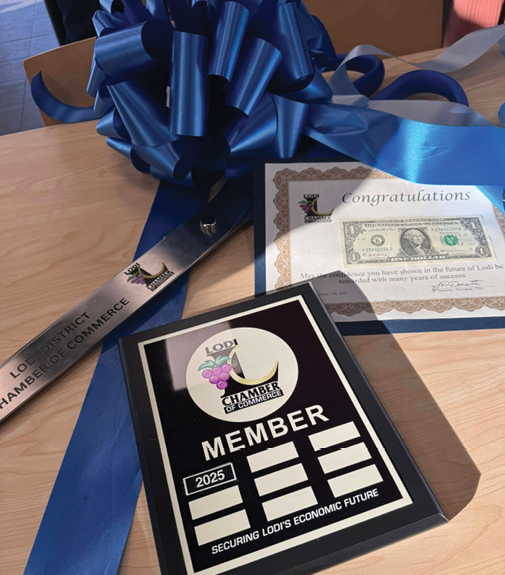


5 REASONS TO JOIN THE CHAMBER
The Lodi Chamber of Commerce is uniquely positioned to provide support and opportunities for new and
already established businesses. Have you been thinking about joining the chamber but in need of a nudge
to do so? Consider this:
Joining the Chamber . . .
The Lodi Chamber of Commerce will connect your business with the right network, providing high-quality
leadership education and keeping you up to date with trends and current affairs.
Our 600+ members enjoy access to a strong network of like-minded entrepreneurs, professionals and decision-makers. Chamber memberships provide valuable resources and opportunities to help grow your business, increase your visibility through our marketing channels, connect with potential clients and partners at exclusive networking events and improve your skills through our educational workshops.
With the Chamber’s MemberPlus App you can connect with the Chamber 24/7 and easily keep your business profile up to date! The app also allows you to be among the first to see exciting events and deals and connect with other members. Consider it your all-in-one solution for maximizing membership benefits. Designed to enhance your membership experience, the MemberPlus App offers tools to help you network, manage your membership and grow your business. Download the app today and take full advantage of everything the Lodi Chamber has to offer!
How often has it been said that residents are the last to learn about the exciting things happening in their backyards? That’s not the case for residents who are Lodi Chamber members. One reason is because members get access to the Chamber’s biannual magazine, The Advocate, which highlights the best that Lodi has to offer in terms of activities, dining, shopping and unique things to see and do! Don’t miss out.
Every year, the Lodi District Chamber of Commerce partners with travel companies to bring affordable
travel to the public. In 2026, we are traveling to South Africa from September 17-26!
Please note: Travelers do NOT have to be Chamber members to take advantage of the
great deals, but of course, we encourage everyone to explore with Chamber Travel and to become a member,
if possible. Our carefully curated trips offer not just spectacular sights but also unique experiences
that highlight the local culture and traditions. Join us for an unforgettable journey.
For more information, contact Director of Operations Karen Alvarez at [email protected] or (209) 367-7840.
Since its beginning in 1990, Leadership Lodi has been designed to inspire and motivate Lodi area citizens to achieve higher levels of leadership responsibility. The ten-month program provides participants with the necessary information to understand the complexities of the Lodi community. Additionally, the program will provide students with the opportunity to meet and exchange ideas with current community leaders. Participants will discuss, explore and learn about topics such as leadership dynamics, government, education, law, agribusiness, economic development, health and the arts. Want to get started? Click here to download the Leadership Lodi application.






























QUICK FACTS
Population:
Median age:
Median household income:
Average home value:
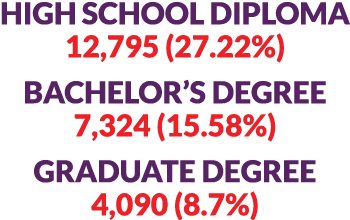
Education
High school diploma
Bachelor’s degree
Graduate degree
Employment rate:
Number of businesses:
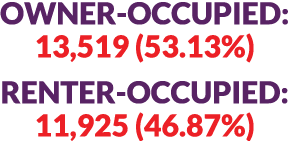
Housing
Owner-occupied:
Renter-occupied:
Tax rate:

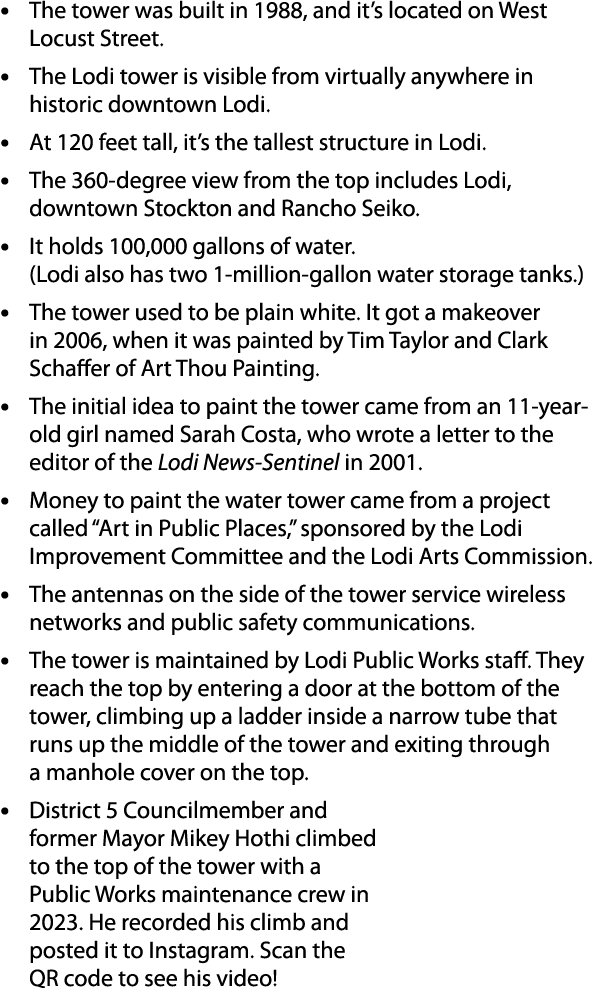


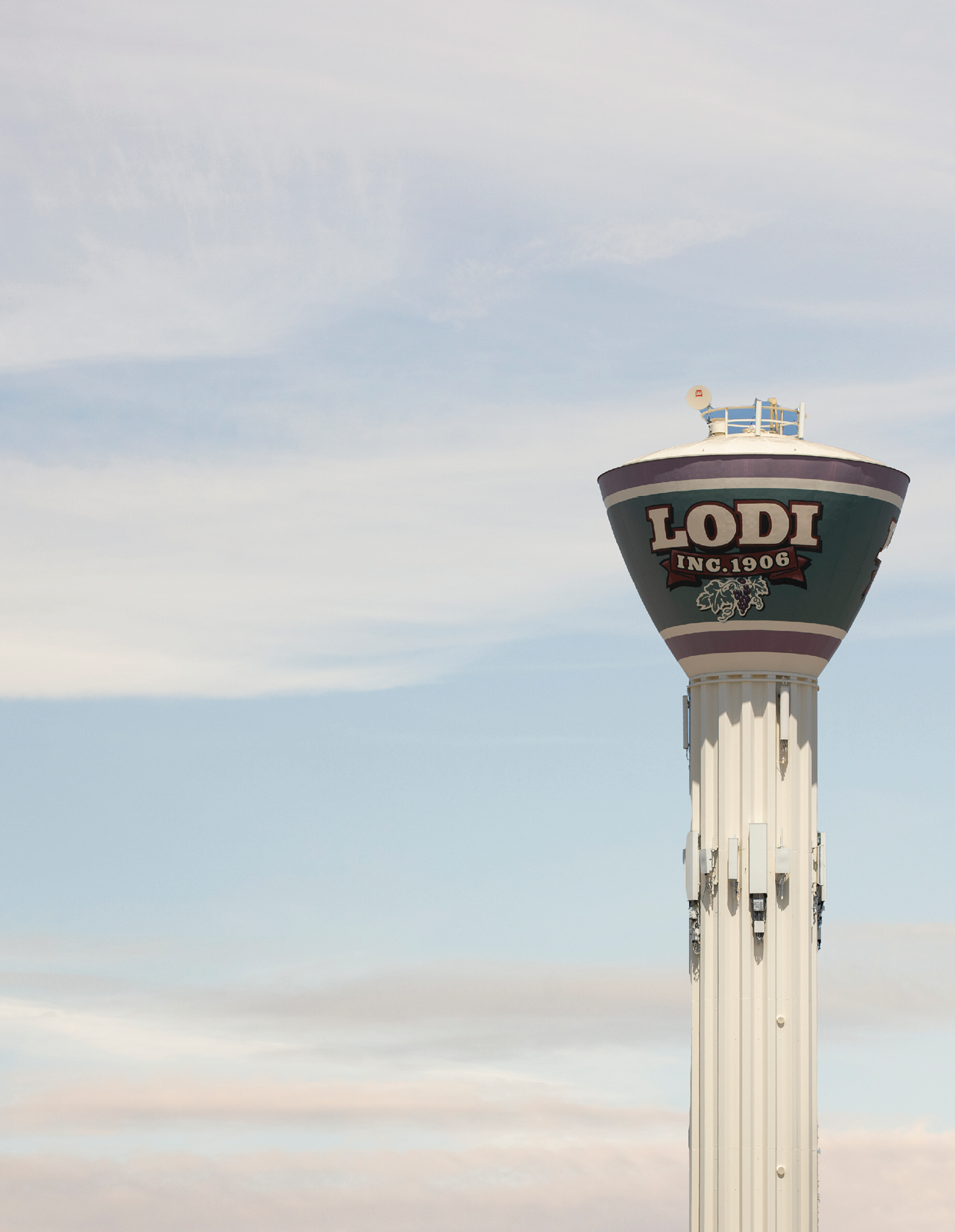
Lodi’s Landmark Water Tower
• The tower was built in 1988, and it’s located on West Locust Street.
• The Lodi tower is visible from virtually anywhere in historic downtown Lodi.
• At 120 feet tall, it’s the tallest structure in Lodi.
• The 360-degree view from the top includes Lodi, downtown Stockton and Rancho Seiko.
• It holds 100,000 gallons of water. (Lodi also has two 1-million-gallon water storage tanks.)
• The tower used to be plain white. It got a makeover in 2006, when it was painted by Tim Taylor
and Clark Schaffer of Art Thou Painting.
• The initial idea to paint the tower came from an 11-year-old girl named Sarah Costa, who wrote a
letter to the editor of the Lodi News-Sentinel in 2001.
• Money to paint the water tower came from a project called “Art in Public Places,”
sponsored by the Lodi Improvement Committee and the Lodi Arts Commission.
• The antennas on the side of the tower service wireless networks and public safety
communications.
• The tower is maintained by Lodi Public Works staff. They reach the top by entering a door at the
bottom of the tower, climbing up a ladder inside a narrow tube that runs up the middle of the tower and
exiting through a manhole cover on the top.
• District 5 Councilmember and former Mayor Mikey Hothi climbed to the top of the tower with a Public Works maintenance crew in 2023. He recorded his climb and posted it to Instagram. Scan the QR code to see his video!





Community Events
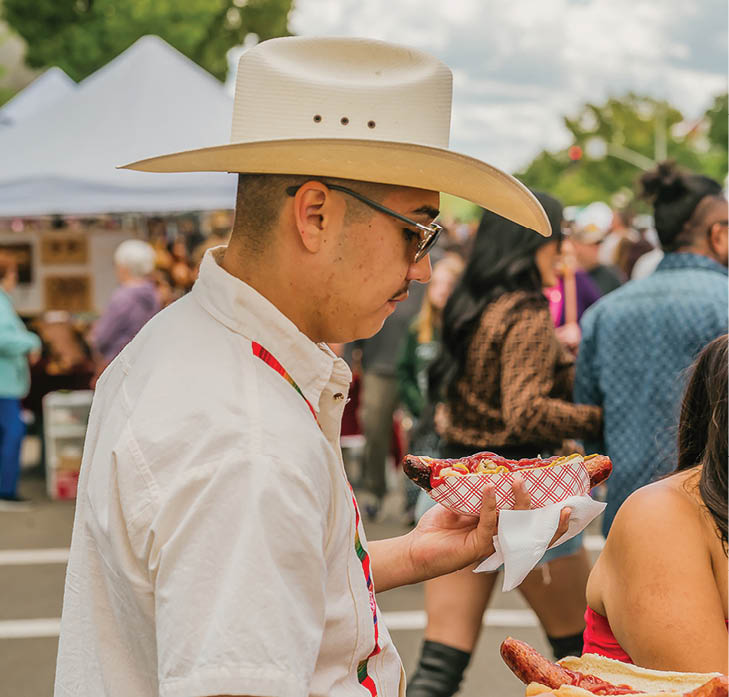
The two largest parties in downtown Lodi are both hosted by the Lodi District Chamber of Commerce: the
Lodi Street Faire and the Lodi Farmers Market. These events aren't just places to snag some fresh
produce and unique crafts; they're all about bringing our community together, having a blast and making
memories.
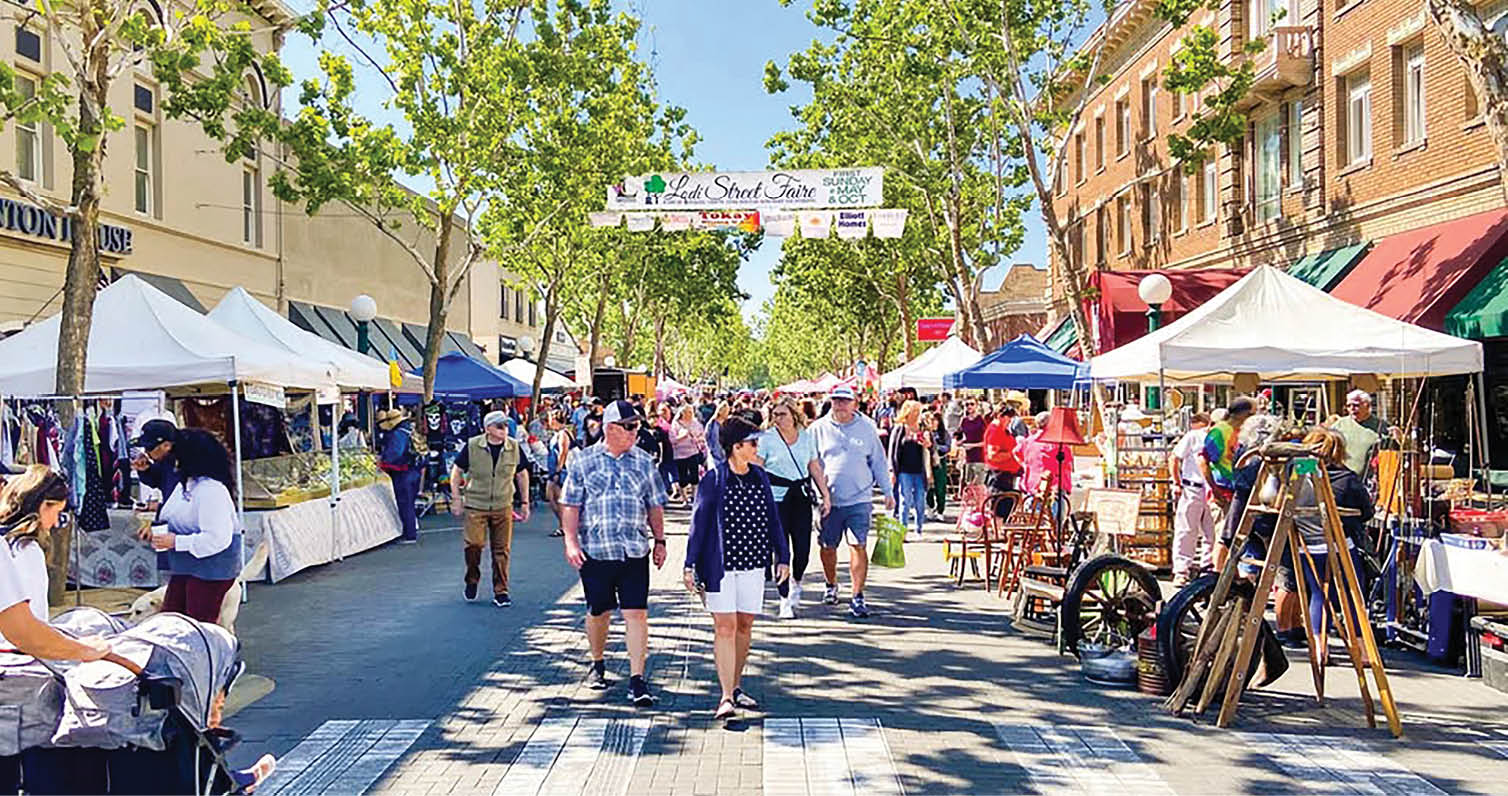
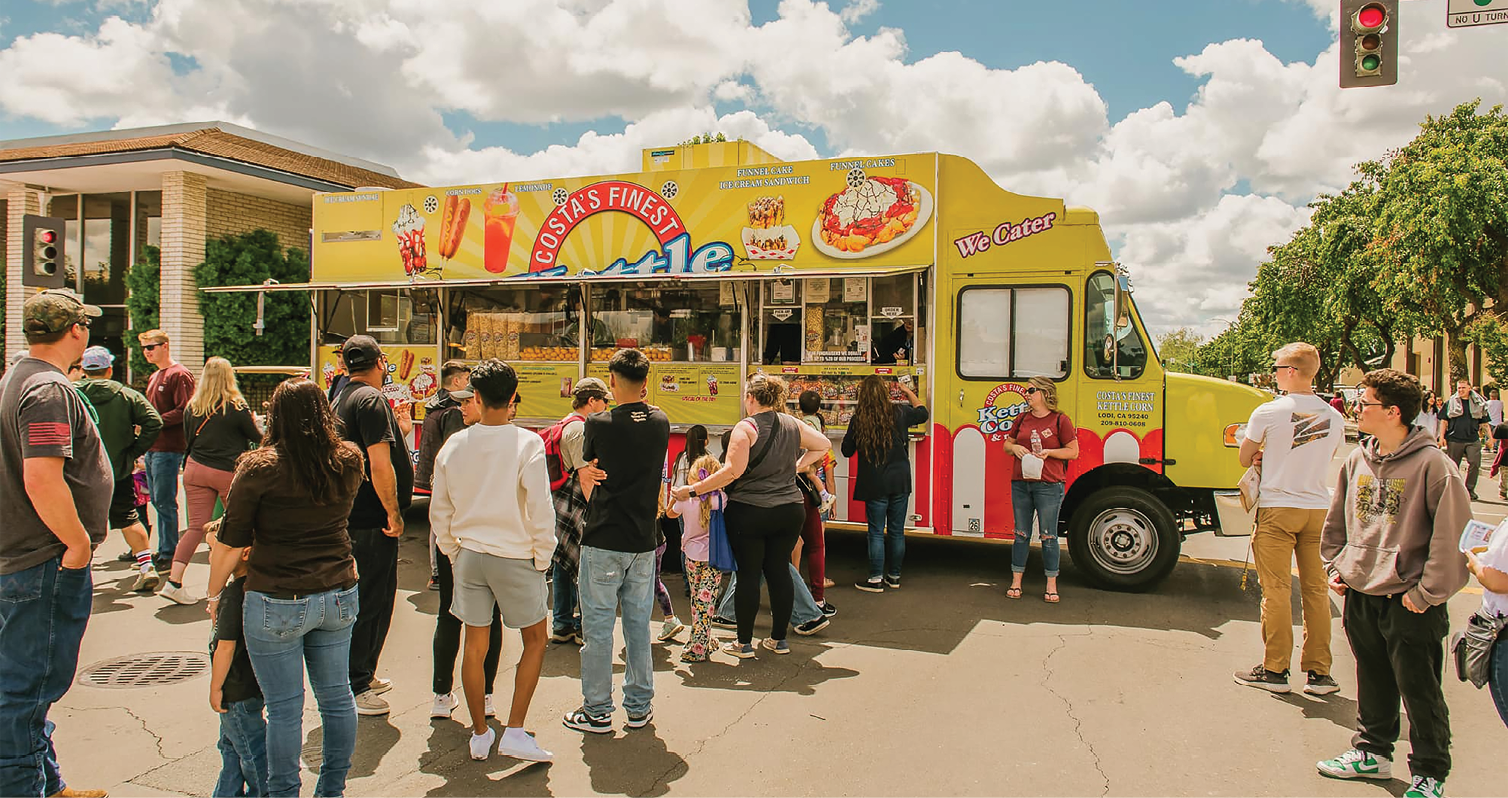
Picture this: twice a year, Lodi transforms into a buzzing hub of local awesomeness. The Lodi Street
Faire takes over, filling the streets with local artists, unique merchants and food wizards. If you're
into finding one-of-a-kind treasures of all kinds, this is your playground. People are seen leaving the
fair with arms full of clothes, records, artwork or even small trees!
Kids can be seen eating funnel cake, sipping fresh squeeze lemonade and perusing shops full of toys and
cute collectables. The fall offers a pumpkin patch featuring all types of interesting gourds. In the
spring, the police and fire departments bring out their vehicles and kids can be seen playing a fireman
and Swat team member or pointing at the drone flying overhead.
Then there's the Lodi Farmers Market, a weekly fiesta for foodies and social butterflies. Located right
in the heart of Lodi, this market bridges the gap between farmers and food lovers. It's where you meet
the folks who grow your grub and learn about sustainable farming practices. It's like going behind the
scenes of your dinner plate.
As you wander through the vibrant stalls, you'll find fresh, local produce that's as Instagram-worthy
as it is delicious. But it's not just about the food. The market is where social bonds grow. With a beer
garden located near the live band stage, and a wine garden on the other end being serenaded by an
acoustic stage, it's the perfect place to chill, chat and enjoy the community vibe.
These gatherings don't just vanish once they're over. They leave a lasting impression. Supporting local
businesses isn't just a feel-good gesture; it's a ticket to a strong local economy. These events bring
thousands of locals and visitors alike to the downtown area, showcasing downtown’s boutiques,
tasting rooms and restaurants.
And that sense of camaraderie and shared experiences at these events? It doesn't stop when the stalls
pack up. It's the glue that holds the community together. It's the stories you share with neighbors, the
friends you make and the knowledge that you're part of something bigger than yourself that keep these
events so popular.
The Lodi Street Faire and the Lodi Farmers Market are more than just places to buy stuff. They're
expressions of our community spirit. They're where we come together, have fun, and celebrate our town's
unique charm. They remind us of the power of local love, shared experiences and the wonderful sense of
belonging.
Whether you're indulging in scrumptious bites, discovering quirky crafts or just enjoying good company, these events shout out the vibrant tapestry of our community life.




TRAVEL LIKE YOU LIVE
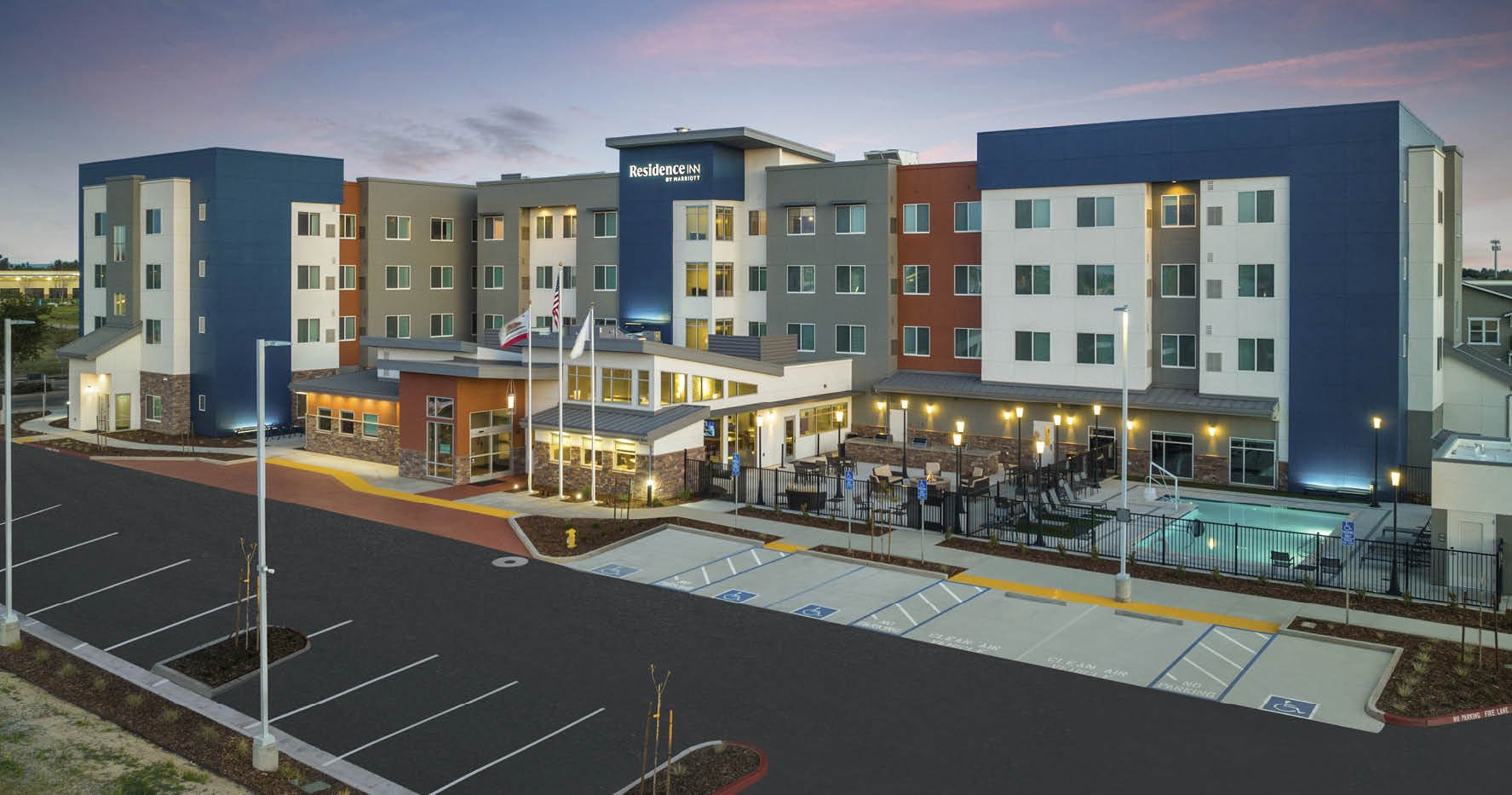
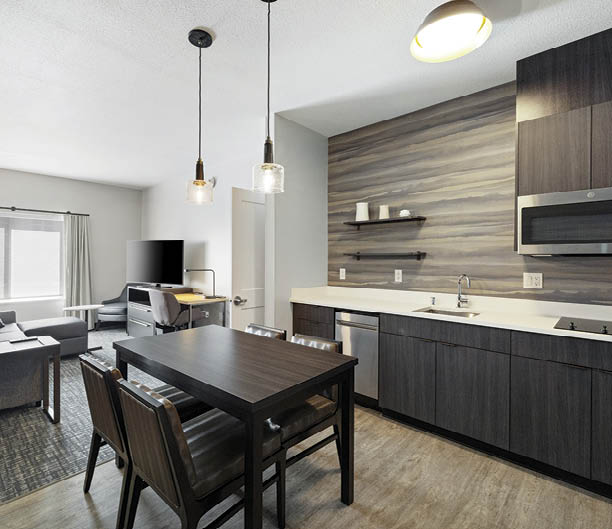
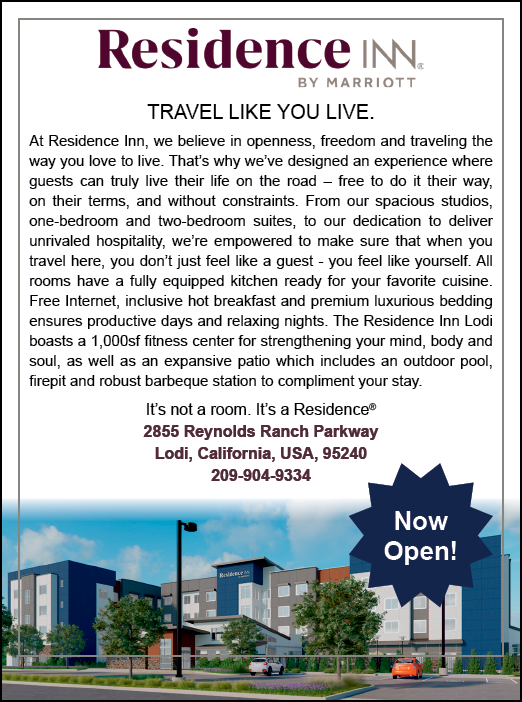
At Residence Inn Lodi, we believe in openness, freedom and traveling the way you love to live.
That’s why we’ve designed an experience where guests can truly live their life on the road
– free to do it their way, on their terms and without constraints. From our spacious studios,
one-bedroom and two-bedroom suites, to our dedication to deliver unrivaled hospitality, we’re
empowered to make sure that when you travel here, you don’t just feel like a guest - you feel like
yourself. All rooms have a fully equipped kitchen ready for your favorite cuisine. Free Internet,
inclusive hot breakfast and premium luxurious bedding ensures productive days and relaxing nights. The
Residence Inn Lodi boasts a 1,000sf fitness center for strengthening your mind, body and soul, as well
as an expansive patio which includes an outdoor pool, firepit and robust barbeque station to complement
your stay.
It’s not a room. It’s a Residence®
2855 Reynolds Ranch Parkway
Lodi, California, USA, 95240
Sales: 209.642.1397
Main: 209-904-9334
Residence Inn by Marriott is the global leader in the longer stays lodging segment with more than 870
properties in over 15 countries and territories. Guests have the freedom to travel the way they live
with Residence Inn’s spacious suites featuring distinct living, working, and sleeping spaces.
Travelers can maximize their time and thrive while on the road with fully equipped kitchens in each
suite, 24/7 grab-and-go markets and complimentary breakfasts. The warm and inviting public spaces
feature modern residential design allowing guests to feel right at home, paired with the added amenities
of upscale hotel living. Residence Inn is proud to participate in Marriott Bonvoy, the global travel
program from Marriott International. The program offers members an extraordinary portfolio of global
brands, exclusive experiences on Marriott Bonvoy Moments and unparalleled benefits including free nights
and Elite status recognition. To enroll for free or for more information about the program, visit MarriottBonvoy.com.
For more information or reservations, visit
Lodi Hotels
Best Western I-5 Inn & Suites
6411 Banner Road, Lodi, CA 95242
(209) 367-3000
Fairfield Inn & Suites by Marriott
262 Rocky Lane, Lodi, CA 95240
(209) 268-7500
Hampton Inn & Suites Lodi
1337 S. Beckman Road, Lodi, CA 95240
(209) 369-2700
Holiday Inn Express Lodi
1341 E. Kettleman Lane, Lodi, CA 95240
(209) 210-0150
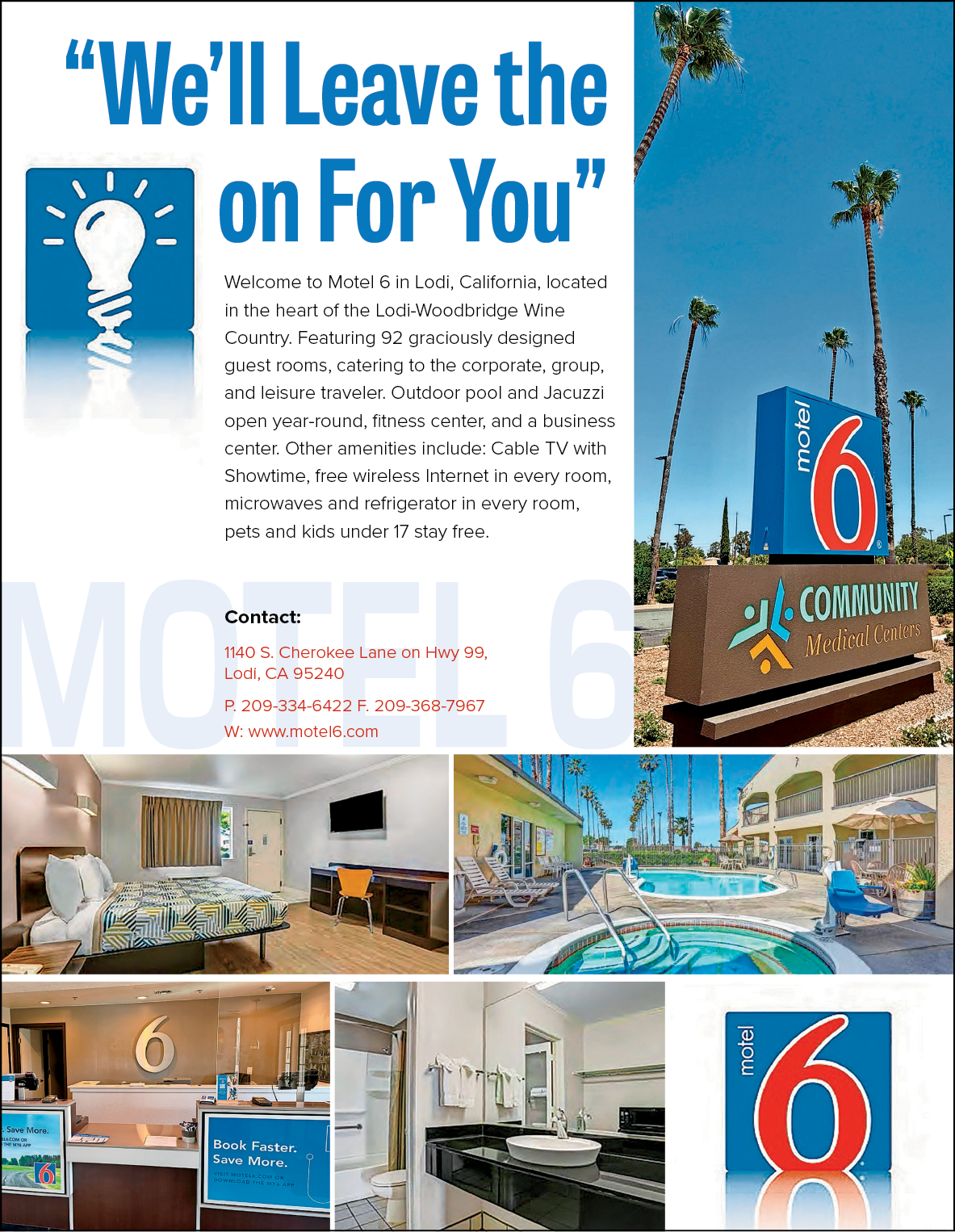
Motel 6
1140 S. Cherokee Lane, Lodi, CA 95240
(209) 334-6422
Wine & Roses
2505 W. Turner Road, Lodi, CA 95242
(209) 334-6988
Bed & Breakfast
Bella Vino Bed & Breakfast
255 S. Hutchins, Lodi, CA 95240
(937) 830-0591
Grape Escape Inn & Suites
333 W. Locust Street, Lodi CA 95240
Lodi Hill House
826 S. Church Street, Lodi, CA 95240
(775) 401-1479





















KIDS GET THEIR KICKS IN LODI 10 KID-FRIENDLY ACTIVITIES
Learn to dance
Explore at a STEM camp
Take a tumble
Watch a movie
Play a sport
Take a swim
Walk a trail
Create art
Make music
Learn to bake
In Lodi, the activities are endless for adults to play and pamper themselves. It turns out that kids of
all ages also have a boatload of things to do to keep their energy meters high.
Did you know that Lodi has more than 30 parks nearby, many outfitted with playgrounds and other cool
outdoor amenities? Plus, of course, there is Lodi Lake, which is great for after-school picnics,
Saturday hikes and spring break days spent fishing or kayaking.
Turns out that there are multiple ways that tots and teens can spend their time having fun in Lodi.
They can:
• Join a sports league, team or an intramural tournament – there are leagues for
basketball, baseball, softball, soccer and more!
• Walk the nature trails at Lodi Lake, Roget Park, Orchard Lane Park and DeBenedetti
Park
• Take the Pumpkin Plunge in October, or a swim class for recreation or
lifeguarding
• Watch a family friendly Movies Under the Columns feature film
• Wiggle, waddle or pirouette in a Dance Class
• Learn how to be crafty
• Flip, flop or roll on a tumbling mat
• Camp out and learn about STEM and other cool coding adventures
• Take to the stage to sing or play an instrument
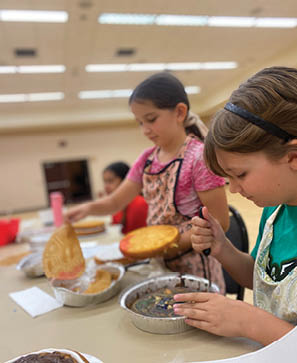
• Don a chef’s hat and learn to bake like a pro
The Parks & Rec Department is a great way to springboard your child into constructive activity –
any time of year. Why? “It provides a space for them to feel comfortable, happy and feel like
they’ve accomplished something,” said Emerson Yellen, deputy director of Parks, Recreation,
and Cultural Services for the City of Lodi.
The best part is that there is something at the Parks & Rec Department for everyone to do, at every age
level. “If you’re looking to have a good time, hang with friends, learn a skill and meet
people, this is the place for you,” Yellen added. “We will help you to find what you
enjoy.”
Learn more about these activities and more:
Parks, Recreation and Cultural Services
https://www.lodi.gov/258/Parks-Recreation
Lodi Boosters of Boys and Girls Sports








LIVING IN LODI
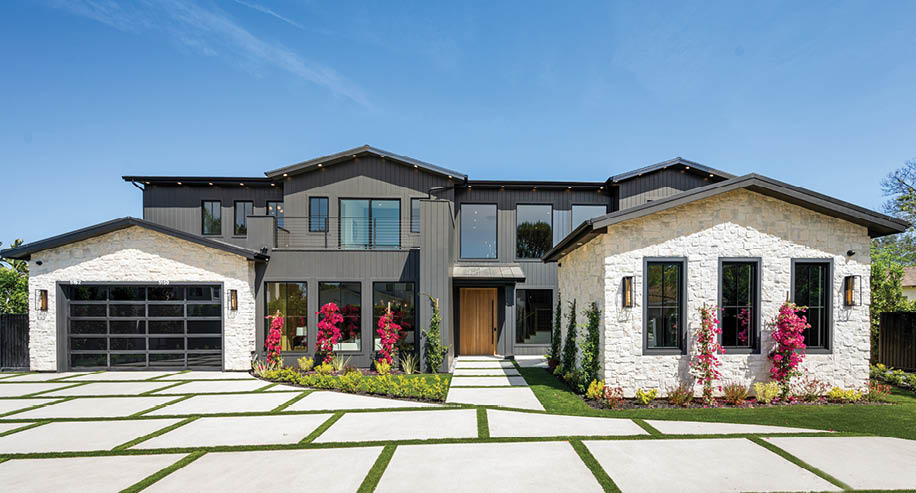
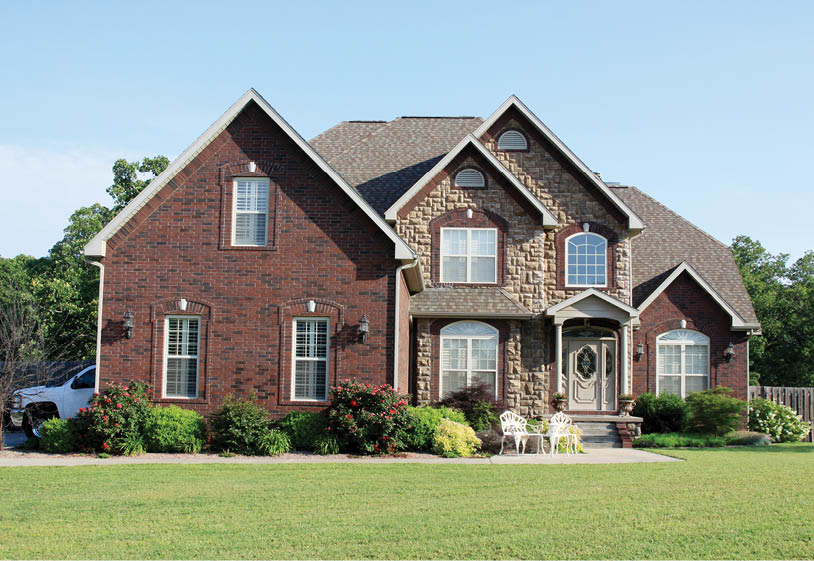
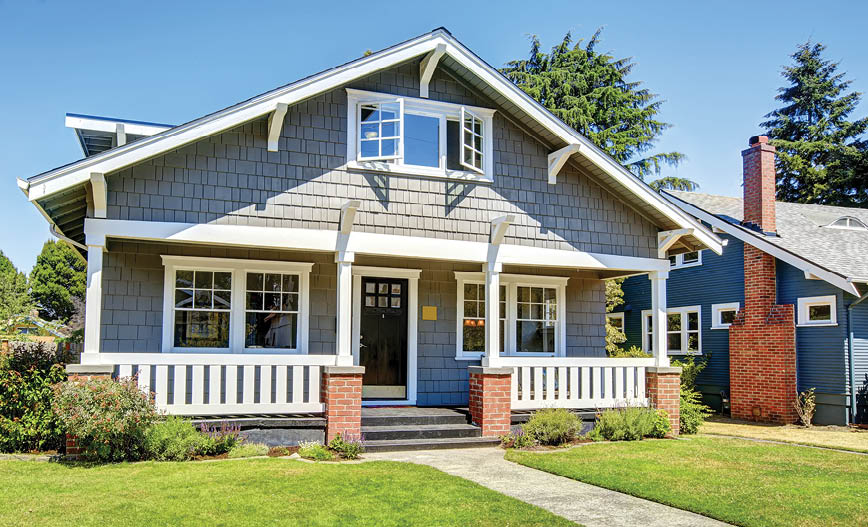
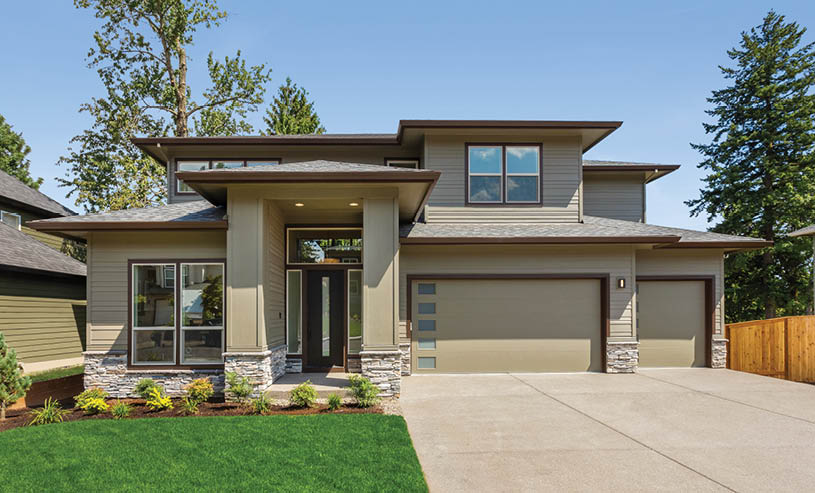
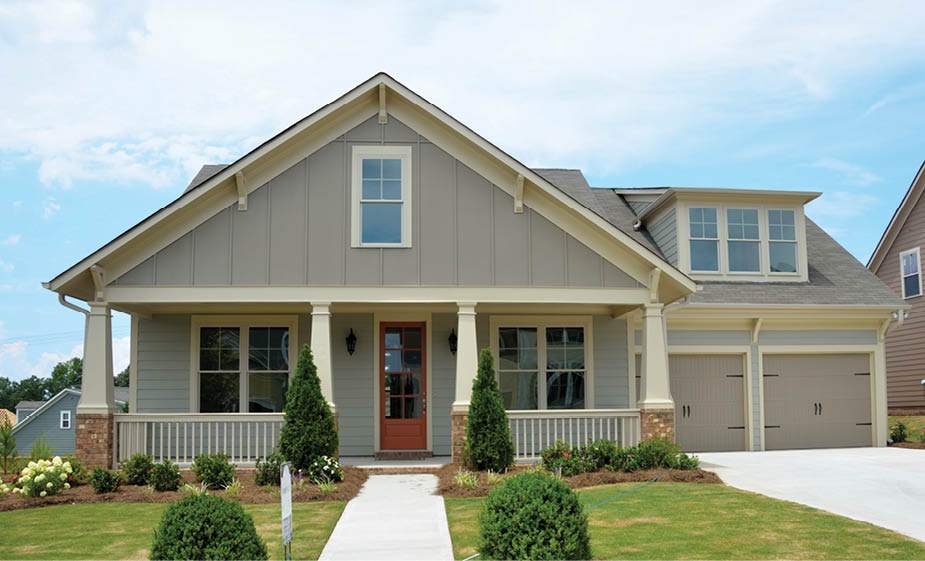
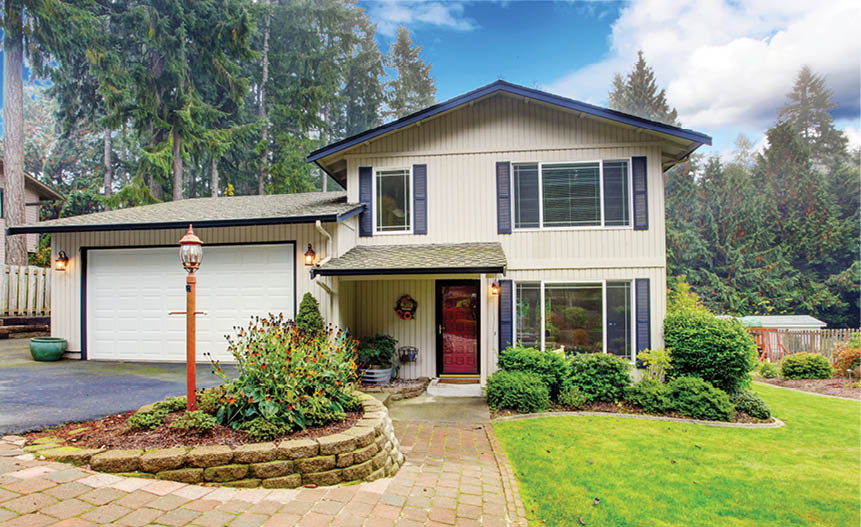
Thinking about moving to Lodi?
You’re in for a treat. Not only is there a lot to do around every corner, every neighborhood has
a treasure trove of living spaces just waiting to welcome you home.
Lodi’s small western community of Sunwest has highly rated schools, popular restaurants, parks
and wine vineyards nearby. There are regular community events and access to downtown Lodi, where there
are even more wineries and the town’s famed farmers market. Sunwest is a popular residential area
with a mix of housing options.
Home of Lodi’s famed Street Faire, Central Lodi sits in the middle of the city and is close to
downtown. There is a varied selection of home types (at various price points) here, from new
construction to midcentury homes. The area also has several open green spaces. Residents enjoy local
shopping and dining options here and nearby in Downtown Lodi.
North Lodi is known for its affordability, good schools and low crime rate. Located on the outskirts of
the city, North Lodi is surrounded by vineyards and farmland. Its homes are affordable and range from
new builds to midcentury styles. The area is home to Lodi High School, which is highly rated, and
residents can easily access Lodi Lake, the farmers market and wineries from the area.
East Lodi is close to plenty of local amenities and is in close proximity to other areas of Lodi and
sits east of the downtown core. Events at Blakely Park are a draw here as is Lodi Lake. East Lodi is
also not too far from Sacramento and Stockton by way of Highway 99. You’ll see a mix of newer and
older homes here.
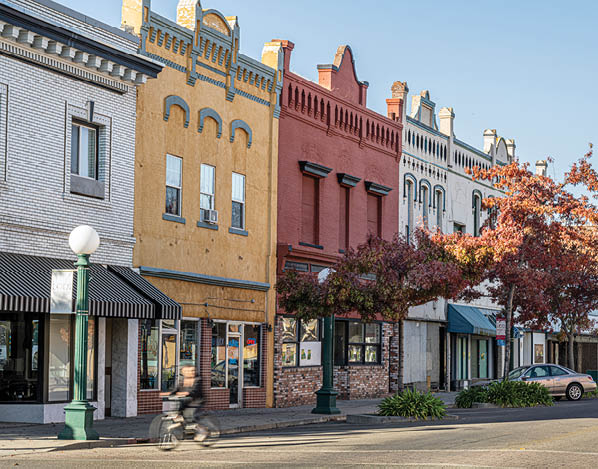
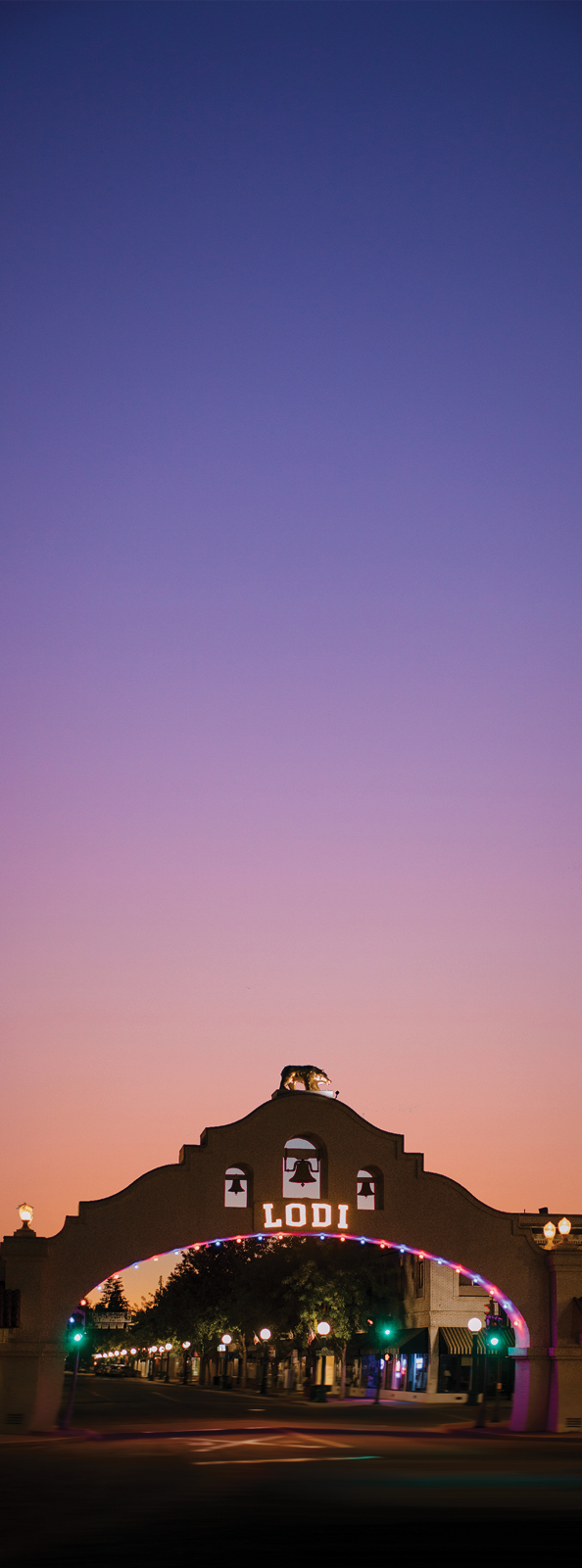
Downtown Lodi draws visitors and residents alike with its wine culture and tasting venues. There are
multiple historic sites, such as the Lodi Arch and the opera house. Downtown Lodi is the vibrant mix of
specialty shops, restaurants, wine tasting rooms, a cinema and more.
Source: Homes.com






Learning in Lodi
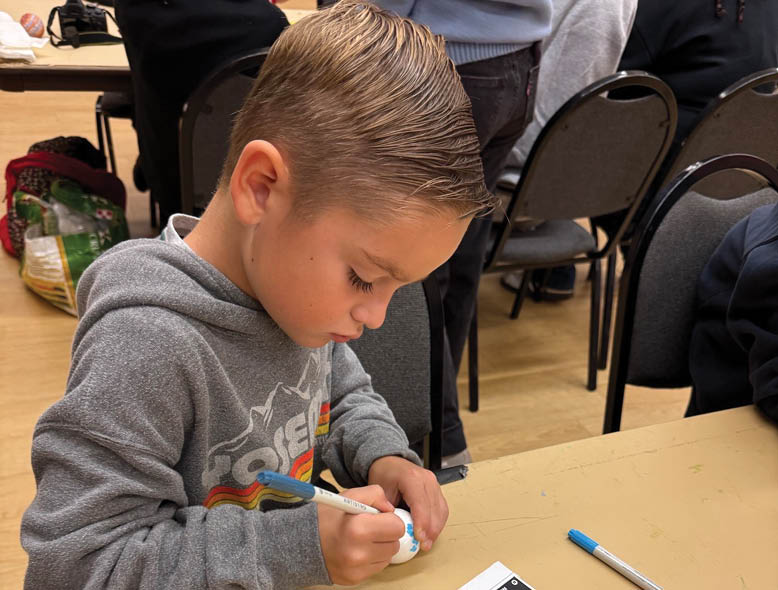
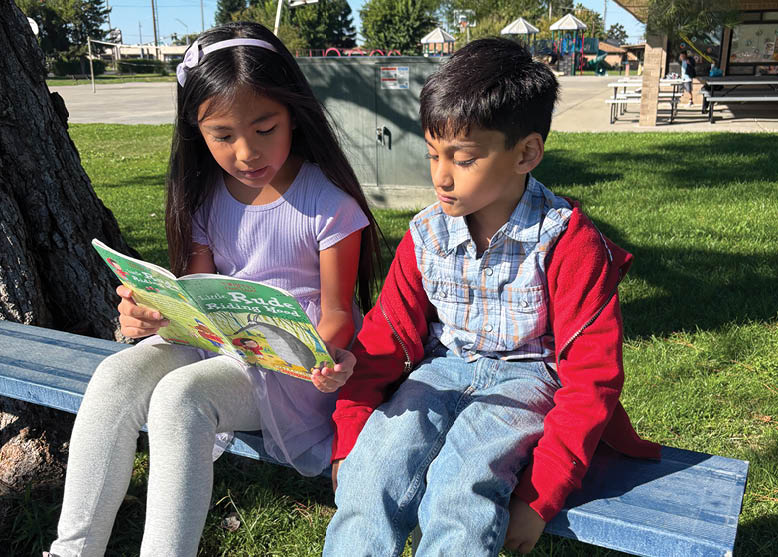
One of the most important aspects of any community is education. Lodi is proud of its schools and the resources it offers to all community members, both children and adults.
Live Oak School
5099 E. Bear Creek Rd
Lodi CA 95240
(209) 331-7370
Lockeford School
19456 N. Tully Rd
Lockeford CA 95237
(209) 331-7214
Lodi High School
3 S. Pacific Ave
Lodi CA 95242
(209) 331-7702
Lodi Middle School
945 S. Ham Ln
Lodi CA 95242
(209) 331-7544
Lodi Unified School District
1305 E. Vine St
Lodi CA 95240
(209) 331-7010
Manlio Silva Elementary
5224 E. Morada Ln
Stockton CA 95212
(209) 953-9302
Nichols School
1301 S. Crescent Ave
Lodi CA 95240
(209) 331-7378
Oakwood School
1315 Woodcreek Way
Stockton CA 95209
(209) 953-8392
Parklane School
8405 Tam O Shanter Dr
Stockton CA 95210
(209) 953-8410
Plaza Robles High School
9434 Thornton Rd
Stockton CA 95209
(209) 953-8068
San Joaquin Delta College
5151 Pacific Ave
Stockton CA 95207
(209) 954-5018
Tokay Colony School
13520 E. Live Oak Rd
Lodi CA 95240
(209) 331-7438
Tokay High School
111 W. Century Blvd
Lodi CA 95240
(209) 331-7935
Victor School
17670 N. Bruella Rd
Victor CA 95253
(209) 331-7441
Vinewood School
1600 W. Tokay St
Lodi CA 95242
(209) 331-7445
Wagner Holt School
8778 Brattle Pl
Stockton CA 95209
(209) 953-8407
Washington School
831 W. Lockeford St
Lodi CA 95240
(209) 331-7451
Westwood School
9444 Caywood Dr
Stockton CA 95210
(209) 953-8333
10Century Assembly
550 W. Century Blvd
Lodi CA 95240
(209) 334-3225
FUNdamentals
6838 Pacific Ave
Stockton CA 95207
(209) 715-9154
Liberty Christian Academy
550 W. Century Blvd
Lodi CA 95240
(209) 395-3145
Lodi Academy
1230 S. Central Ave
Lodi CA 95240
(209) 368-2781
Lodi Christian School
751 S. Lower Sac Rd
Lodi CA 95242
(209) 368-7627
Lodi SDA Elementary School
1240 S. Central Ave
Lodi CA 95240
(209) 368-5341
Rio Valley Charter School
1110 W. Kettleman Lane, Ste 10
Lodi CA 95240
(209) 368-4934
Sayla Music Academy
21 W. Locust St
Lodi CA 95240
(209) 981-4303
St. Anne’s School
200 Pleasant Ave
Lodi CA 95240
(209) 333-7580
St. Peter Lutheran School
50 S Lower Sacramento Rd
Lodi CA 95242
(209) 333-2225






5 Questions With . . .
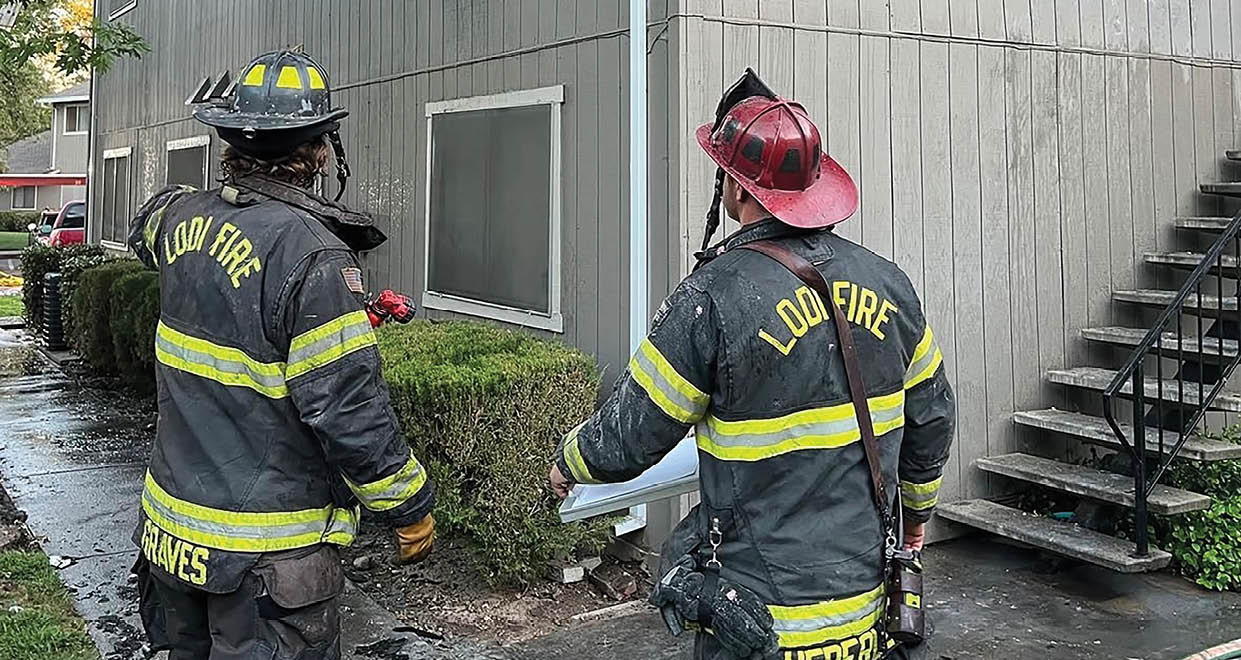
On television, firefighters are made to look like people with herculean strength who overcome
relationship woes and combat fiery challenges in a single episode. But we decided to speak with two
members of the Lodi Fire Department to get the real scoop.
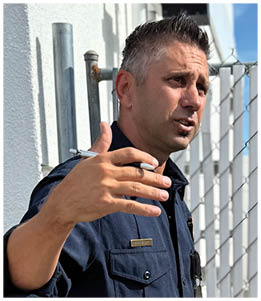
Fire Marshal, Lodi Fire Department
Smart is a Battalion Chief who oversees the fire prevention bureau and organizes all fire prevention
activities for the Lodi Fire Department, including inspections, plan reviews and preparedness plans for
the city. He started his fire career as a volunteer in 2001. He worked for the Stockton Fire Department
for 22 years and recently accepted the position as fire marshal for the LFD a few months ago.
Our primary emergencies are medical emergencies. That could be a typical medical illness, but we also
respond to vehicle accidents, where we render medical care and extrication if someone is pinned in. We
also take priority of containment of hazardous materials and heavy rescues in confined spaces, like in
underground tanks, pipes and tunnels.
It’s still true what we’ve heard since childhood:
Make sure that there is a fire detector and carbon dioxide detector. Make sure that the batteries are
regularly changed (although newer detectors come with sealed batteries) and keep an extinguisher readily
available.
With families, we go out to schools and teach about emergency preparedness plans. You don’t want
to think about what to do when you need it. You have to have a plan ahead of time.
One way to do this: cleanliness is very helpful. Kitchen fires and electrical fires - in many cases
they could be avoided. They spread quicker because of the elements around them. A light coat of grease
can spread fire much quicker than if it were wiped off and clean. An accumulation of paper, trash, mail
close to an ignition source will contribute to the fire spread, too.
We are all guilty of being busy, but we have to discipline ourselves to be prepared for any potential
situation.
In the end, the result of many different fires can be similar in nature, but drastic differences in
outcomes, depending on the environment.
I have, and it happens, but it’s not common. I’ve had second-degree burns, but usually
it’s from steam, not fire.
Our PPE (personal protective equipment) is designed very well. There are situations where it’s
not foolproof; there are risks involved. Our equipment is designed to keep us very protected. It’s
not fireproof, but it can withstand significant temperatures.
You would think that fire and heat were the leading hazards, but the biggest problem is the smoke in an
environment. It can be fatal.
The most common is an ABC extinguisher. It’s the most common and general.
A - For lightweight combustible materials, like wood, paper, cloth.
B - For flammable liquids, petroleum and greases.
C- For fires involving electrical equipment.
In my broad experience, the leading cause of residential fires in general is kitchen/cooking fires.
I’d also argue that people should be cognizant and pay attention to their homes, in general. If
you have a breaker that keeps tripping or lights flickering or an outlet with a flash, that could be a
big hazard for an electrical fire. Electrical fires can be hidden for some time, if the short happens
inside the wall.
Another big concern: lithium ion batteries (in computers, ebikes, laptops, vape pens). Pay attention to
devices that have these batteries. Don’t leave them on the charger all the time. If they are
damaged, they could self ignite. And when they catch fire, they can get pretty violent. Store them
outside in the garage. It’s an efficient technology with a lot of battery life and storage, but
we’re finding there’s much more of a fire potential and hazard than with the alkaline
batteries that we grew up with.
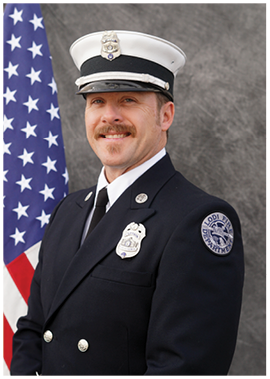
Engine Captain, Lodi Fire Department
Captain Kris Graves has been in fire service 20 years, 17 of which he has served with the Lodi Fire
Department. He is part of a crew of three.
I don’t react the same way to stress as most people. We are trained to see and mitigate certain
things. I also feel fortunate to have a wife that is very understanding. In our home, I have a room for
napping. In other words, there are times that I do try to get away because things can get so frenetic
and you need to recharge. I also have dogs at home that love me to death.
It looks very real, but it is made for TV. To a degree, yes, firefighters do stop what they’re
doing when the siren rings. And, yes, there’s the camaraderie. That’s absolutely real, but a
lot of the other stuff is played up a little bit.
It was hard to get a job with a fire department when I was looking. It took me three years of actively
testing (in Santa Rosa, Long Beach, Sacramento), which is not uncommon. So, why do I want to do this
job? I want to help people. You get to see people at their absolutely worst day and then try to make it
better. It’s a needed service, and they want us to be there. I want to make a difference. I want
to be that safe space, help and breath that they need.
We need honesty, integrity and need to be able to trust each other. My guys need to know I have their
best interest at heart. Firefighters must also be hardworking and have a willingness to work. Some of
the things that we have to see and mitigate most humans don’t have to, but you still need to get
the job done.
The big difference about living in California than in any other part of the country is that we deal
with wild fires every year. Just this past year, in the Palisades, there were millions in property
loss.
If we are sending blanket statements, saying leave your home and evacuate - GO. We need you to listen
to the orders as they’re given. Educate yourself about what fire service is about.
Don’t just walk by a fire house. Go in and have a conversation. Talk with someone and then go
from there.
When you realize what fire service is, it makes everyone’s job easier.
We’re here for you. We do this job for you. I do what I do for this community. It’s a crazy thing.






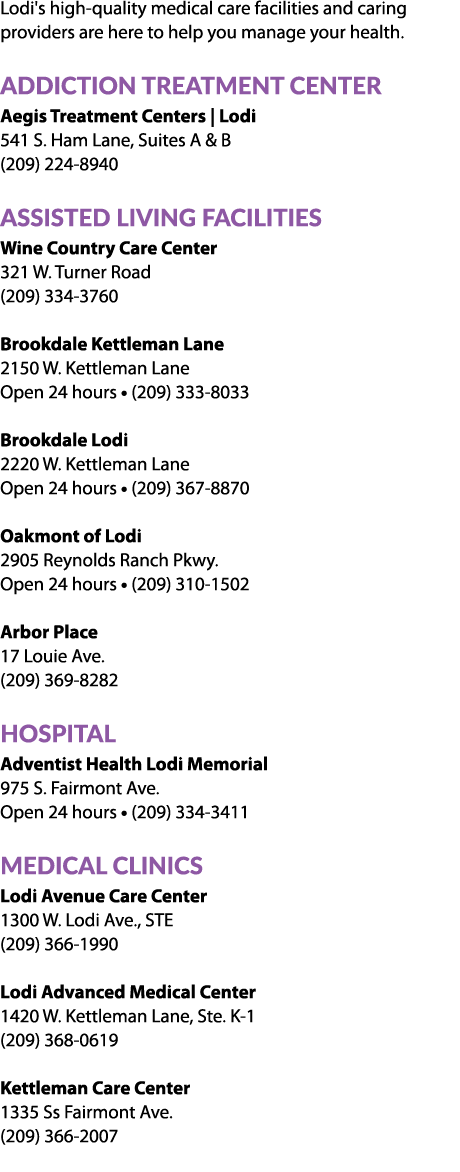


HEALTH CARE
Lodi's high-quality medical care facilities and caring providers are here to help you manage your
health.
Aegis Treatment Centers | Lodi
541 S. Ham Lane, Suites A & B
(209) 224-8940
Wine Country Care Center
321 W. Turner Road
(209) 334-3760
Brookdale Kettleman Lane
2150 W. Kettleman Lane
Open 24 hours • (209) 333-8033
Brookdale Lodi
2220 W. Kettleman Lane
Open 24 hours • (209) 367-8870
Oakmont of Lodi
2905 Reynolds Ranch Pkwy.
Open 24 hours • (209) 310-1502
Arbor Place
17 Louie Ave.
(209) 369-8282
Adventist Health Lodi Memorial
975 S. Fairmont Ave.
Open 24 hours • (209) 334-3411
Lodi Avenue Care Center
1300 W. Lodi Ave., STE
(209) 366-1990
Lodi Advanced Medical Center
1420 W. Kettleman Lane, Ste. K-1
(209) 368-0619
Kettleman Care Center
1335 Ss Fairmont Ave.
(209) 366-2007
Fairmont Avenue Care Center
999 S. Fairmont Ave., Suites 130, 200
(209) 366-2001
Adventist Health Lodi Memorial Adult Day Services
125 S. Hutchins St.
(209) 369-4443
CMC Lodi Turner
2401 W. Turner Road # 450
(209) 370-1700
Fairmont Rehabilitation Hospital
950 S. Fairmont Ave.
Open 24 hours • (209) 368-0693
Lodi Nursing & Rehabilitation
1334 S. Ham Lane
(209) 334-3825
Lodi Creek Post-Acute
321 W. Turner Road
Open 24 hours • (209) 334-3760
Arbor Rehabilitation & Nursing Center
900 N. Church St.
(209) 333-1222
Vienna Nursing & Rehab Center
800 S. Ham Lane
Open 24 hours • (209) 368-7141
Adventist Health Lodi Memorial Acute Physical Rehab
975 S. Fairmont Ave.
Open 24 hours • (209) 333-3100
Urgent Care: Adventist Health Lodi Memorial
1235 W. Vine St., STE 20
(209) 339-7600













OLIVE OIL & WINE FRESH FROM THE VINE
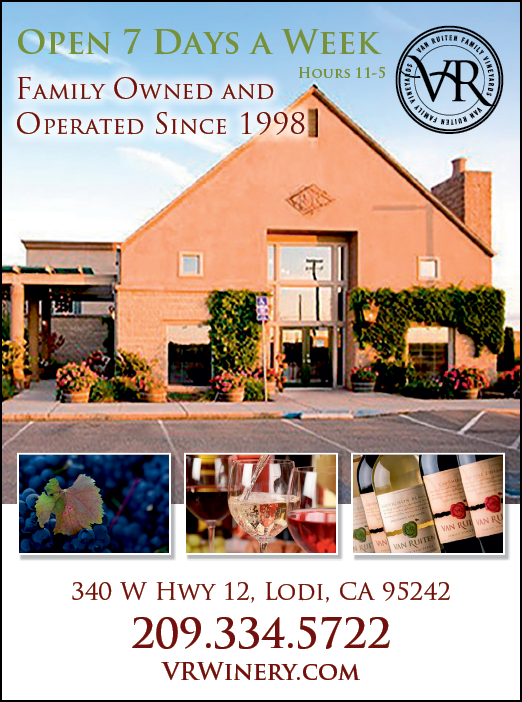
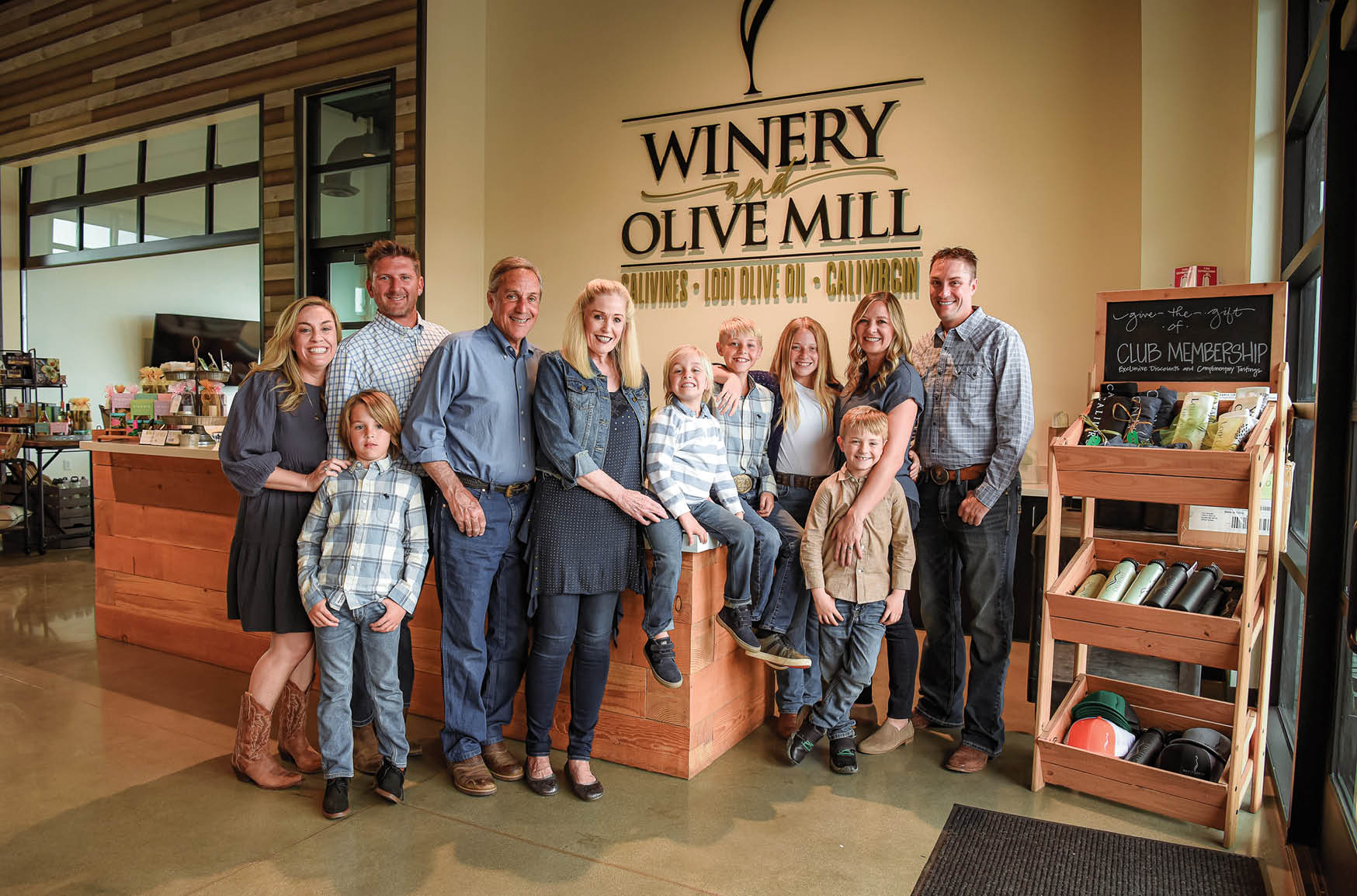
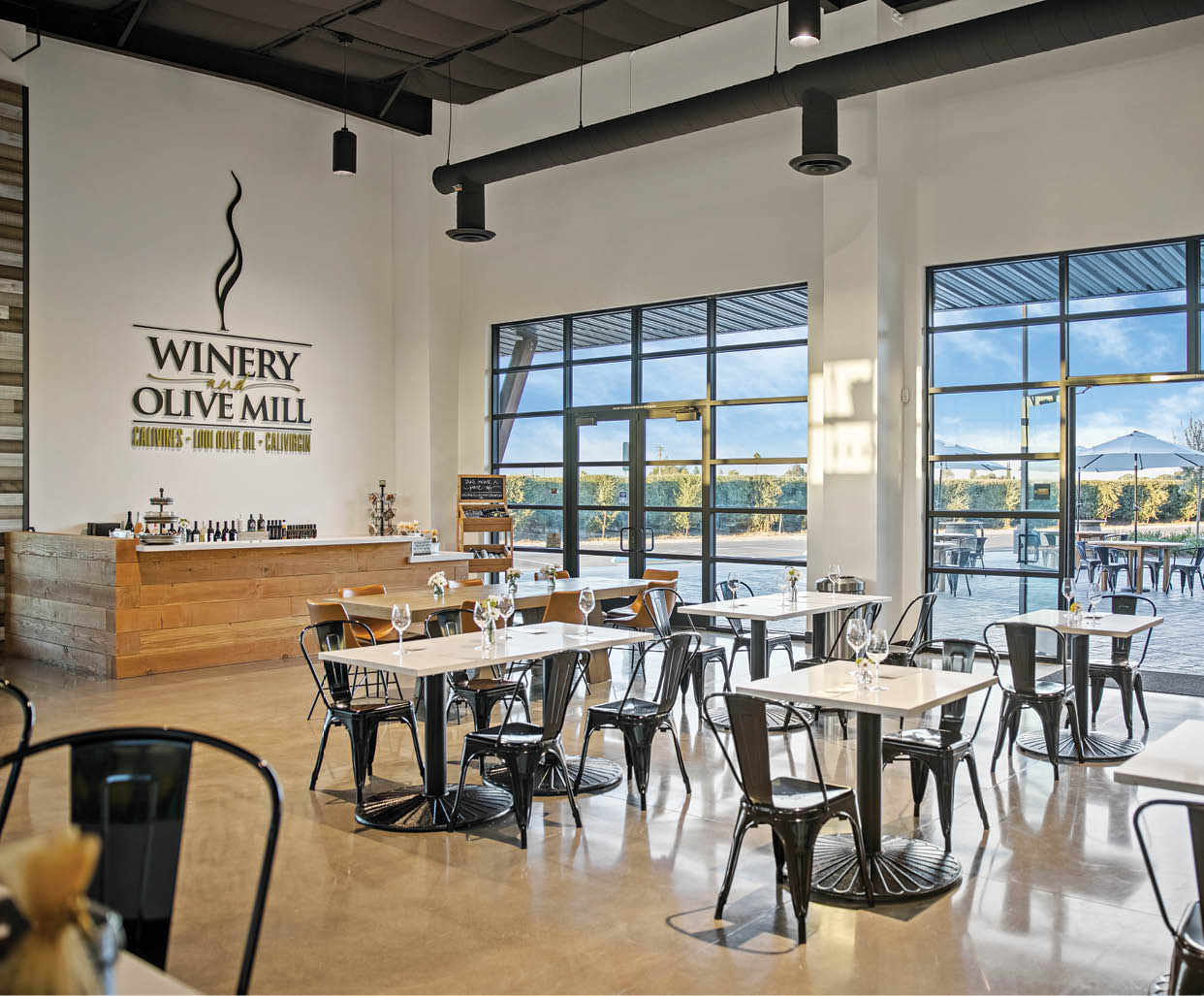
Calivines Winery & Olive Mill offers a unique farm-to-table experience where visitors can taste
award-winning olive oils, sample wines and learn about a century-long family tradition of farming. The
property combines a new winery with a 20-year-old olive oil business, creating a destination where
agriculture, flavor and community come together.
“We’ve actually been farming in this area for over 100 years, but it wasn’t until
about 20 years ago that we put in a permanent olive crop,” said Julie Coldani, owner of Calivines.
“That was really the first step in creating a brand for our olive oil. One thing led to another,
and now we do everything from tree to bottle.”
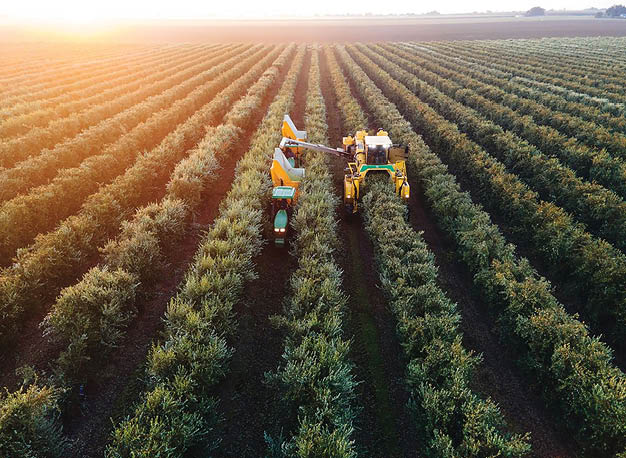
The olive trees themselves are a central attraction. “One of our olive orchards surrounds the
tasting room,” she said. “They’re planted in a super high-density system, which is
different from traditional olive trees. They’re on trellises, planted in rows, so we can machine
harvest them. The machine goes over the top and shakes the olives off, which is efficient but still
maintains the integrity of the fruit. We harvest once a year, in October or November, right after the
grape harvest.”
Variety is at the heart of Calivines’ olive oils.
“For olives, we primarily grow over 150 acres of Arbequina, and we also have some
Koroneiki,” Coldani explained. “Then, we handpick Ascolano and Frantoio. For our flavored
oils, we literally crush the olives with fresh produce on top. Lemon, limes, blood orange, garlic,
rosemary, basil, we make about 14 flavors this way. That’s one reason we’ve been so
successful. We’re the most-awarded olive oil company in the US making flavored oils this
way.”
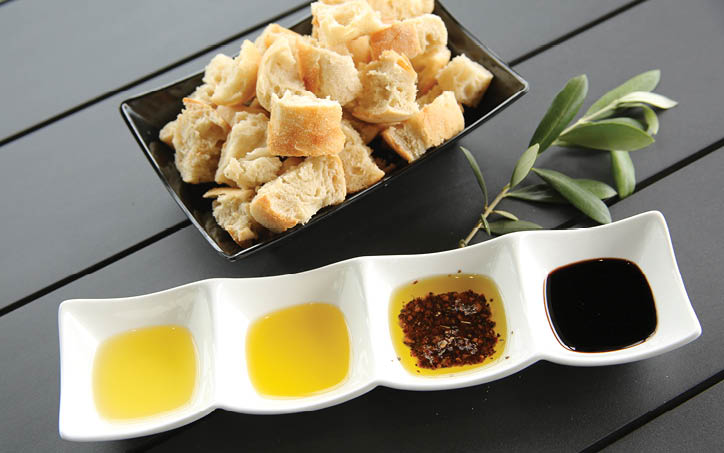
Visitors can explore the oils every day. “We have a self-serve olive oil bar open daily where
guests can taste different oils and balsamic vinegars,” she said. “And then we also offer
seated olive oil tastings. We bring the oils to you with fresh bread and talk you through the process of
growing and preparing them while you taste. There’s even a video in the tasting room showing the
harvesting process.”
The tasting experience often extends to food.
“We try to incorporate the oils into the small bites we serve at the winery,” Coldani
offered. “Guests can see what they can do with the oils in recipes, and surprisingly, we even have
a dessert on the menu—olive oil on ice cream—which is delicious.”
The winery is a newer addition, celebrating its fourth year.
“The winery and tasting room are fairly new, but it made sense to expand because we were already
connected to the land and the produce. Now, visitors can enjoy both olive oil and wine in the same
beautiful space.”
Guests can enjoy wine tastings paired with small bites, browse a gift shop of seasonal merchandise and
gourmet foods and even host private or corporate events on the property.
The current business model was different from what they had planned.
“Originally, we planned to just farm and sell the olives,” Coldani said. “We had a
contract with someone to buy them, and we milled them into oil intending to sell in bulk, but we
couldn’t find a buyer. So, we realized we needed a label. We bottled and sold at farmers markets
while still working our regular jobs. Eventually, we invested in our own mill, and my husband, Mike,
handles the milling. It’s a true family business. My sister-in-law and in-laws, and some amazing
team members work with us every day.”
Community engagement is a priority for Calivines.
“We have loyal club members, so we’re always trying new events, music and activities, and
we change our menu regularly. When you’re selling a healthy product, it feels good because
you’re helping your customers. They can taste the oil, see the trees and touch the leaves. We feel
good about providing this for Lodi, providing jobs and giving back to the community as much as we
can.”
Calivines Winery & Olive Mill is located at 13950 N. Thornton Road in Lodi, CA, 95242. For more information, call (209) 210-3162 or visit www.calivirgin.com.
"When you’re selling a healthy product, it feels good because you’re helping
your customers."
-Julie Coldani, owner








DINING IN LODI
Plus, Lodi’s First Restaurant Week Celebration
In Lodi, you have plenty of ways to satiate your appetite. Craving tacos? Let Fuego Prime spice up your
taste buds. Want pizza with organic flair? There’s Smack Pie Pizza. Looking for sushi or teriyaki?
Then, stop by Shangri-La Asian Bistro. Ready to wine and dine with that special someone? Try the Brick
House Restaurant for a casual Italian or Lodi Papapavlos for Mediterranean fare. Lodi offers food that
appeals to every taste and budget. There are quick fast food options for people on the go, coffee stops,
bars and bistros, bakeries and cafes.
Plus, visitors and locals can enjoy a celebration of culinary delights during the city’s first
Restaurant Week. The 10-day dining extravaganza, Jan. 23-Feb. 1, 2026, will bring Lodi’s local
flavors to life, as participating restaurants offer limited-time, prix-fixe menus for all to enjoy.
Learn more here: https://visitlodi.com/dining/lodi-restaurant-week/
Hungry? The options are endless in Lodi.
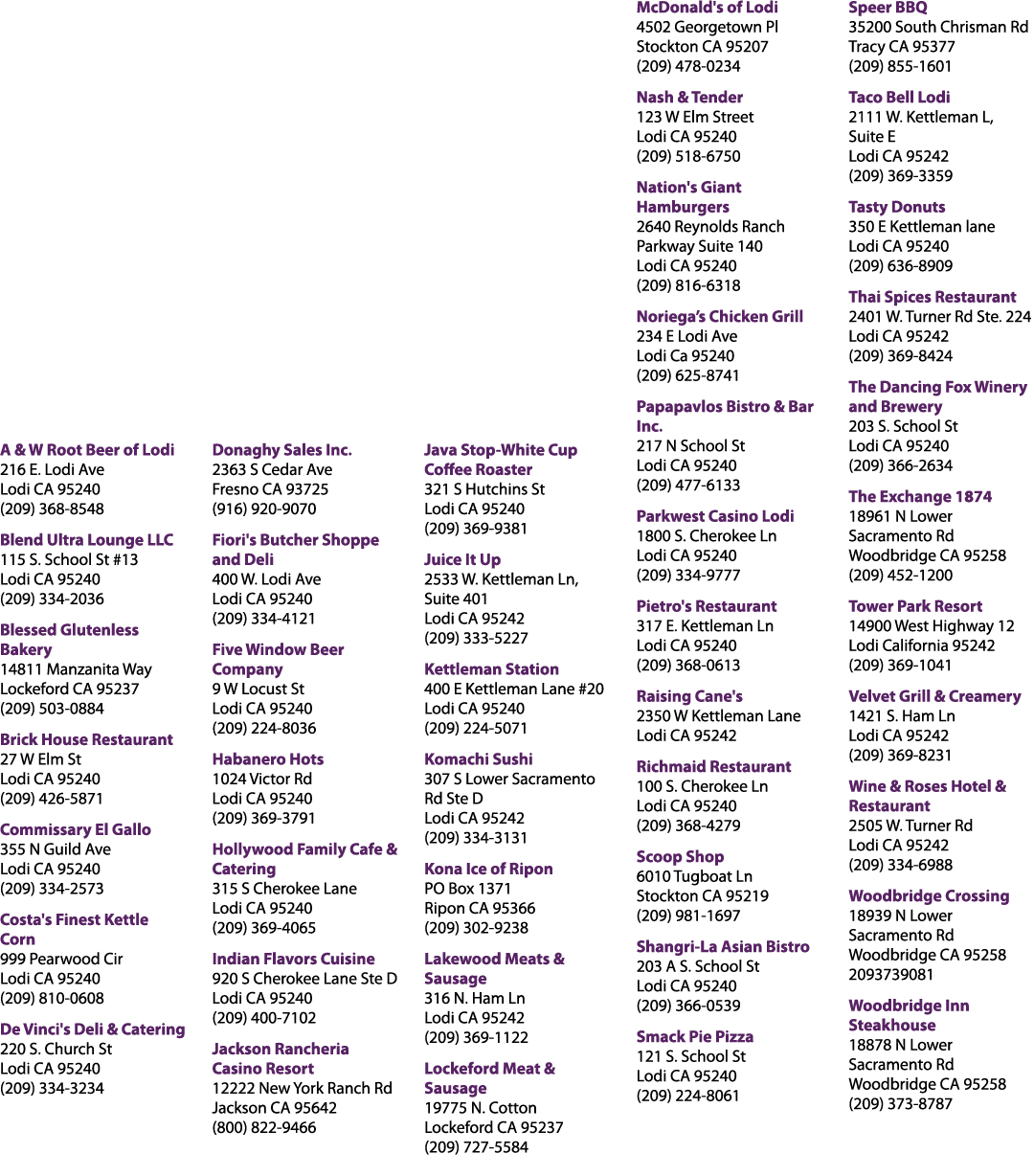
A & W Root Beer of Lodi
216 E. Lodi Ave
Lodi CA 95240
(209) 368-8548
Blend Ultra Lounge LLC
115 S. School St #13
Lodi CA 95240
(209) 334-2036
Blessed Glutenless Bakery
14811 Manzanita Way
Lockeford CA 95237
(209) 503-0884
Brick House Restaurant
27 W Elm St
Lodi CA 95240
(209) 426-5871
Commissary El Gallo
355 N Guild Ave
Lodi CA 95240
(209) 334-2573
Costa's Finest Kettle Corn
999 Pearwood Cir
Lodi CA 95240
(209) 810-0608
De Vinci's Deli & Catering
220 S. Church St
Lodi CA 95240
(209) 334-3234
Donaghy Sales Inc.
2363 S Cedar Ave
Fresno CA 93725
(916) 920-9070
Fiori's Butcher Shoppe and Deli
400 W. Lodi Ave
Lodi CA 95240
(209) 334-4121
Five Window Beer Company
9 W Locust St
Lodi CA 95240
(209) 224-8036
Habanero Hots
1024 Victor Rd
Lodi CA 95240
(209) 369-3791
Hollywood Family Cafe & Catering
315 S Cherokee Lane
Lodi CA 95240
(209) 369-4065
Indian Flavors Cuisine
920 S Cherokee Lane Ste D
Lodi CA 95240
(209) 400-7102
Jackson Rancheria Casino Resort
12222 New York Ranch Rd
Jackson CA 95642
(800) 822-9466
Java Stop-White Cup Coffee Roaster
321 S Hutchins St
Lodi CA 95240
(209) 369-9381
Juice It Up
2533 W. Kettleman Ln, Suite 401
Lodi CA 95242
(209) 333-5227
Kettleman Station
400 E Kettleman Lane #20
Lodi CA 95240
(209) 224-5071
Komachi Sushi
307 S Lower Sacramento Rd Ste D
Lodi CA 95242
(209) 334-3131
Kona Ice of Ripon
PO Box 1371
Ripon CA 95366
(209) 302-9238
Lakewood Meats & Sausage
316 N. Ham Ln
Lodi CA 95242
(209) 369-1122
Lockeford Meat & Sausage
19775 N. Cotton
Lockeford CA 95237
(209) 727-5584
McDonald's of Lodi
4502 Georgetown Pl
Stockton CA 95207
(209) 478-0234
Nash & Tender
123 W Elm Street
Lodi CA 95240
(209) 518-6750
Nation's Giant Hamburgers
2640 Reynolds Ranch Parkway Suite 140
Lodi CA 95240
(209) 816-6318
Noriega’s Chicken Grill
234 E Lodi Ave
Lodi Ca 95240
(209) 625-8741
Papapavlos Bistro & Bar Inc.
217 N School St
Lodi CA 95240
(209) 477-6133
Parkwest Casino Lodi
1800 S. Cherokee Ln
Lodi CA 95240
(209) 334-9777
Pietro's Restaurant
317 E. Kettleman Ln
Lodi CA 95240
(209) 368-0613
Raising Cane's
2350 W Kettleman Lane
Lodi CA 95242
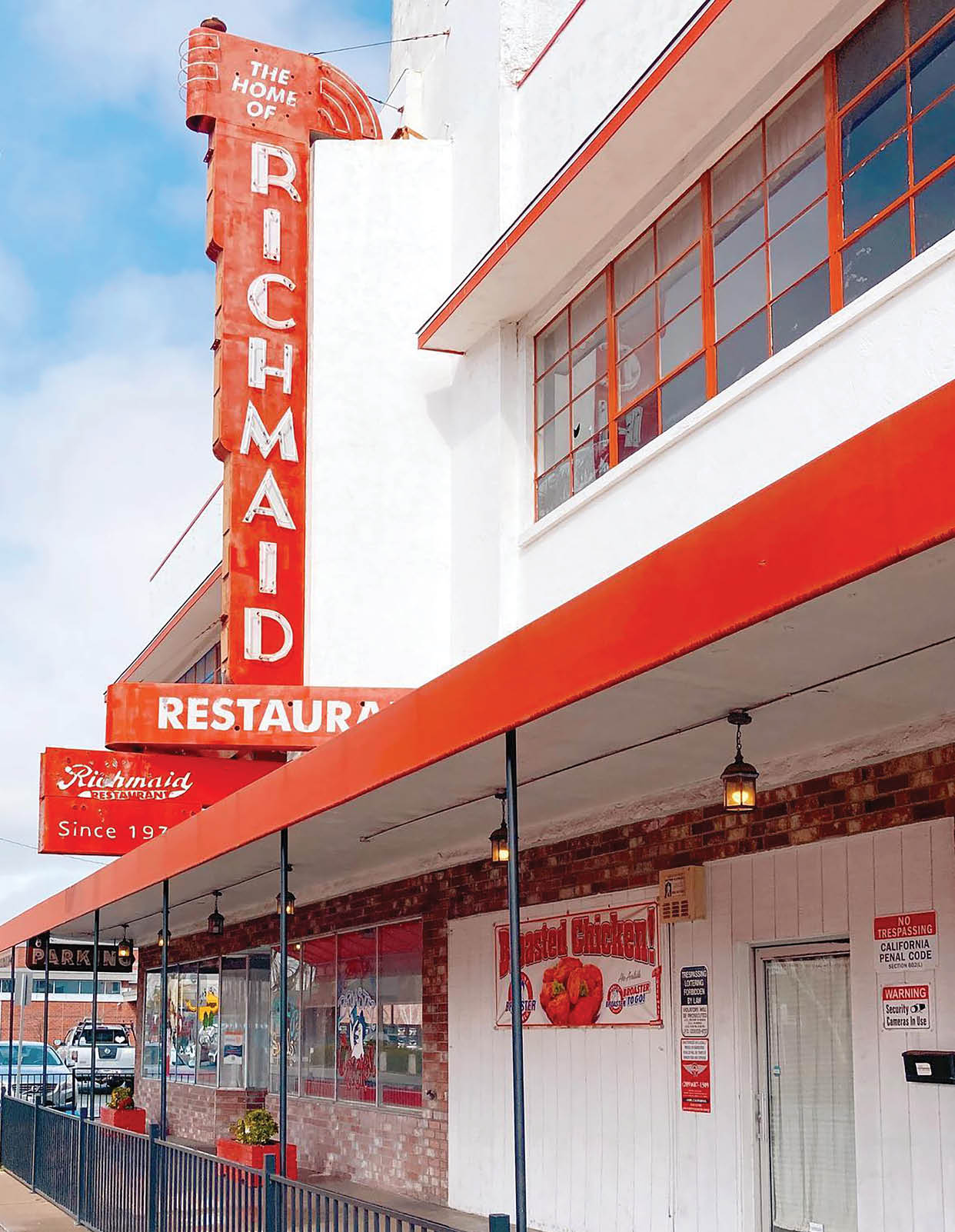
Richmaid Restaurant
100 S. Cherokee Ln
Lodi CA 95240
(209) 368-4279
Scoop Shop
6010 Tugboat Ln
Stockton CA 95219
(209) 981-1697
Shangri-La Asian Bistro
203 A S. School St
Lodi CA 95240
(209) 366-0539
Smack Pie Pizza
121 S. School St
Lodi CA 95240
(209) 224-8061
Speer BBQ
35200 South Chrisman Rd
Tracy CA 95377
(209) 855-1601
Taco Bell Lodi
2111 W. Kettleman L, Suite E
Lodi CA 95242
(209) 369-3359
Tasty Donuts
350 E Kettleman lane
Lodi CA 95240
(209) 636-8909
Thai Spices Restaurant
2401 W. Turner Rd Ste. 224
Lodi CA 95242
(209) 369-8424
The Dancing Fox Winery and Brewery
203 S. School St
Lodi CA 95240
(209) 366-2634
The Exchange 1874
18961 N Lower Sacramento Rd
Woodbridge CA 95258
(209) 452-1200
Tower Park Resort
14900 West Highway 12
Lodi California 95242
(209) 369-1041
Velvet Grill & Creamery
1421 S. Ham Ln
Lodi CA 95242
(209) 369-8231
Wine & Roses Hotel & Restaurant
2505 W. Turner Rd
Lodi CA 95242
(209) 334-6988
Woodbridge Crossing
18939 N Lower Sacramento Rd
Woodbridge CA 95258
2093739081
Woodbridge Inn Steakhouse
18878 N Lower Sacramento Rd
Woodbridge CA 95258
(209) 373-8787




Not Just a Wine Town
Picture yourself on vacation in wine country, setting the tone for each day, your tranquil smile
reflected in the fresh black coffee, the floral scent of a light roast rising with the steam, which
gently blurs the green fields of the Central Valley. The trip's impermanence makes each sip more
precious. Or maybe you're a latte person, reluctant to distort your barista's artwork in the foam, the
tip of a heart stretching from your lip like the string of a balloon as you float up to cloud nine.
Lucky for you, Lodi – long renowned for its world-class wines – features a wide array of
lesser-known coffee shops that locals love.
True to the name, this family-owned cafe in the heart of downtown Lodi inspires connection and
creativity with a cozy aesthetic, featuring earth tones and leather furniture. Venture beyond the
classics with specialty drinks, like lavender-blended coffee and the Aztec Mocha. Local Natalie Morlino,
who doesn't drink caffeine, still loves going to Inspire because it "feels like a Hallmark
movie." Where's your next scene?
https://trailcoffeeroasters.com/?srsltid=AfmBOorv3h0K3tceLph7Ng_cLnVBBWiHGqquQU8pH-pQWSqRe9L6NQru
Connoisseurs love Trail Coffee’s emphasis on craft, the single-origin beans from the shop’s
own farms in Nicaragua and local, small-batch roasting. Dedication to quality transcends coffee here to
include freshly baked, in-house pastries. If you're looking for the best coffee in Lodi, you're hot on
the trail.
https://www.brewhousecoffeelodi.com/
Open seven days a week until 8 p.m., Brew House on School Street provides a charming place to recharge
between a day of wine tasting and an evening out. If your group can't decide between caffeine and
alcohol, Brew House accommodates, offering everything from coffee and tea to cocktails and wine
slushies. They also have a location on Cluff.
https://www.cafecitolounge.com/
If you're in the mood for a more vibrant ambiance, consider Cafecito, which offers horchata lattes and
fresh pan dulce in a lively yet cozy environment. Frequent community events make it a great place to
meet new friends and make lasting memories with old ones. The horchata latte, though. Seriously?
Yum.
https://visitlodi.com/directory/house-of-coffees/
This gem has been a favorite of locals and visitors alike for over 30 years. To find the epitome of
Lodi's small-town appeal, look no further. House of Coffees is known for not only its quality and
aesthetics but also its exceptional service and hospitality.
https://visitlodi.com/directory/julis-village-coffee-shop/
Don't let the name mislead; Juli's is a beloved local diner with classic comfort food. If your appetite
surpasses the aforementioned pastries, this is the place. Listen to the bacon sizzle. Watch the fluffy
pancakes flip. You're in California: add some avocado to that made-to-order omelette. And wash it all
down with their bottomless coffee. It doesn't take a village to know Juli's is the place to eat and grab
a cup of great coffee.
https://visitlodi.com/directory/java-stop/
Short on time? Make a pit stop at this drive-through coffee shop, conveniently located at 321 S.
Hutchins Street. Three. Two. One. Java.
Notable mentions:
Hit up The Hangout for boba, Tillie's for Thai tea and Ruby's for bakery.





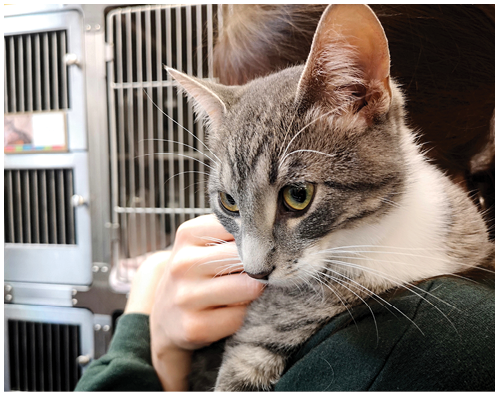

ADOPT A PET IN LODI
Shelters are filled with animals waiting for a forever home. Are you looking for a cuddly new family
member? Why not adopt from a nearby shelter? Not convinced that you should? Consider these reasons to
adopt a shelter animal:
Every year, millions of animals enter shelters and must face euthanasia due to overcrowding. By
adopting, you’re saving that pet’s life.
Shelter animals have an incredible capacity for love and appreciation. Many of them have faced
abandonment or hardship. They’re looking for someone to love deeply.
Adoption fees are generally much lower than purchasing a pet from a breeder or pet store, and most
shelters include vaccinations, spaying/neutering and even microchipping in the adoption fee.
Adopting from a shelter means you’re supporting the efforts of organizations dedicated to animal
welfare. Your adoption fee helps to fund rescue and rehabilitation efforts.
Numerous studies indicate that having a pet can lower stress levels and increase happiness quotients.
The companionship of a shelter animal can enhance your overall mental and emotional well-being.
Adopting a shelter animal is not just about finding a pet; it’s about making a connection that
will impact you as well as your new furry friend. If you’re considering bringing a new pet into
your home, visit your local shelter first. You may change two lives in the process!
Source: For more information, contact the Delta Humane Society, SPCA of San Joaquin County or visit dhsspca.org.