CHILD CARE IN OHIO
What the State Budget Means, and What Comes Next
By Lynanne Gutierrez, Groundwork Ohio | For Focus Magazine
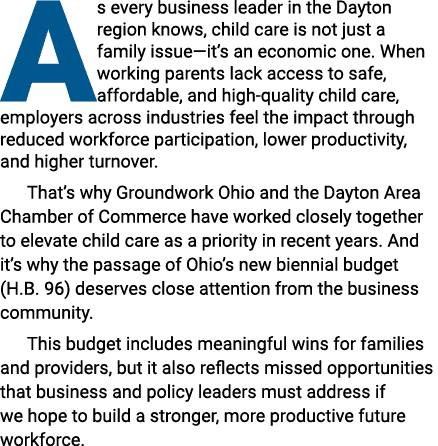
As every business leader in the Dayton region knows, child care is not just a family
issue—it’s an economic one. When working parents lack access to safe, affordable, and
high-quality child care, employers across industries feel the impact through reduced workforce
participation, lower productivity, and higher turnover.
That’s why Groundwork Ohio and the Dayton Area Chamber of Commerce have worked closely together
to elevate child care as a priority in recent years. And it’s why the passage of Ohio’s new
biennial budget (H.B. 96) deserves close attention from the business community.
This budget includes meaningful wins for families and providers, but it also reflects missed
opportunities that business and policy leaders must address if we hope to build a stronger, more
productive future workforce.
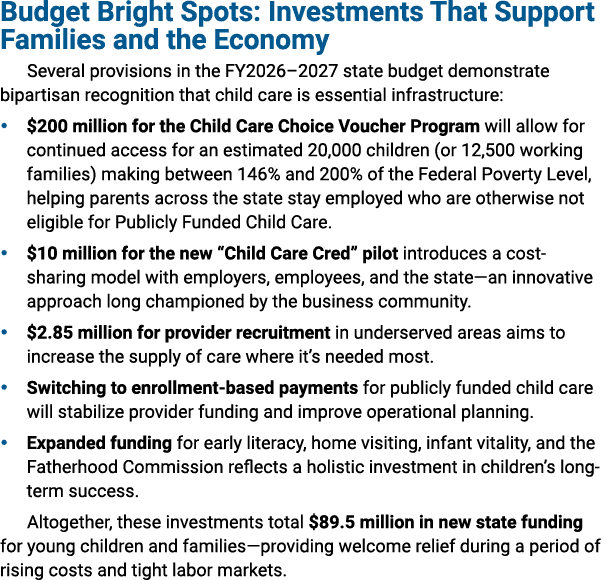
Budget Bright Spots: Investments That Support Families and the Economy
Several provisions in the FY2026–2027 state budget demonstrate bipartisan recognition that child
care is essential infrastructure:
• $200 million for the Child Care Choice Voucher Program will allow
for continued access for an estimated 20,000 children (or 12,500 working families) making between 146%
and 200% of the Federal Poverty Level, helping parents across the state stay employed who are otherwise
not eligible for Publicly Funded Child Care.
• $10 million for the new “Child Care Cred” pilot
introduces a cost-sharing model with employers, employees, and the state—an innovative approach
long championed by the business community.
• $2.85 million for provider recruitment in underserved areas aims to
increase the supply of care where it’s needed most.
• Switching to enrollment-based payments for publicly funded child
care will stabilize provider funding and improve operational planning.
• Expanded funding for early literacy, home visiting, infant vitality,
and the Fatherhood Commission reflects a holistic investment in children’s long-term success.
Altogether, these investments total $89.5 million in new state funding for young
children and families—providing welcome relief during a period of rising costs and tight labor
markets.
Missed Opportunities: Gaps That Threaten Progress
Despite important gains, the budget misses key chances to fully address Ohio’s child care
crisis:
• Eligibility for publicly funded child care remains at 145% of the Federal
Poverty Level (FPL)—the lowest in the nation. A proposed increase to 160% FPL, which
would have served 11,000 additional children, was excluded.
• An additional $25 million for the Voucher Program was not included,
limiting expanded access.
• The refundable Child Tax Credit was not included, despite its
potential to lift families out of poverty and boost local economies.
From a business standpoint, these omissions are more than policy disappointments—they’re
missed opportunities to stabilize Ohio’s workforce and strengthen the state’s long-term
talent pipeline.
Looking Ahead: Collaboration and Action
This mixed outcome reminds us that patchwork solutions won’t solve a growing crisis.
With no additional sustained state investment in child care and an over-reliance on one-time federal
funding, Ohio faces a $600 million shortfall in child care funding in the next
biennium. Without new strategies in place, we risk losing key services that support families and
workforce stability.
That’s why Groundwork Ohio will continue partnering with business leaders, policymakers, and
advocates across sectors. We look forward to learning from promising public-private partnerships and
from new pilots like Child Care Cred. But real, long-term progress will require systemic public
investment including raising eligibility levels, expanding access, and advancing shared public-private
investment in child care as the economic necessity it is.
Final Thoughts
This budget cycle has shown us what’s possible—and what’s still urgently needed. We
applaud Governor DeWine and legislative leaders for protecting core early childhood investments and
appreciate the tireless advocacy of business leaders, child care professionals, families, and
stakeholders who kept children at the center of the debate.
Together, alongside the business community, we will begin to shape what comes next. Whether by piloting
employer-supported child care models, sharing testimony with lawmakers, or investing in local solutions,
Dayton’s business leaders can help move Ohio toward a future where every child—and every
parent—has the opportunity to thrive.
Because when child care works, so does everything else.
Lynanne Gutierrez is President & CEO of Groundwork Ohio, a nonpartisan public-policy research and
advocacy organization that champions high-quality early learning and healthy development
strategies from the prenatal period to age 5, that lay a strong foundation for Ohio kids, families,
and communities. We advance quality early childhood systems in Ohio by engaging, educating, and
mobilizing diverse stakeholders and strategic partners to promote data driven and evidence-based early
childhood policies. To learn more or to get involved,
visit www.GroundworkOhio.org.
This budget cycle has shown us what’s possible—and what’s still urgently
needed.